
Solidion Technology Unveils Patented Extreme-Climate Battery Technology Targeting Low Earth Orbit-Based Artificial Intelligence Data Centers, Lunar Economy, and Space
Rhea-AI Summary
Solidion Technology (Nasdaq: STI) unveiled its patented Generation Extreme-Climate Battery (Gen-ECB), designed for satellites, LEO AI data centers, crewed spacecraft and lunar infrastructure. The graphene-based system manages heat and cold, is reported to operate from −80°C to +60°C, and targets broader ranges for deep-space.
According to the company, Gen-ECB supports Artemis lunar missions with tested performance above 500 charge cycles at −40°C. Solidion also highlights silicon-rich all-solid-state, anode-less lithium metal, and lithium-sulfur batteries targeting 380+ Wh/kg, a 385+ patent portfolio, U.S. green graphite production, and applications in EVs and AI data centers.
AI-generated analysis. Not financial advice.
Positive
- Gen-ECB battery reportedly operates from −80°C to +60°C for extreme environments
- Tested Gen-ECB performance exceeding 500 charge cycles at −40°C for lunar use
- Lithium-sulfur batteries targeting energy density of 380+ Wh/kg
- Portfolio of over 385 patents supporting battery and materials technology
- U.S.-based green graphite production supporting domestic battery supply chain
- Battery platform also targets EVs, AI data center UPS, and aerospace markets
Negative
- None.
News Market Reaction – STI
On the day this news was published, STI gained 350.60%, reflecting a significant positive market reaction. Argus tracked a peak move of +897.2% during that session. Our momentum scanner triggered 163 alerts that day, indicating very high trading interest and price volatility. This price movement added approximately $230M to the company's valuation, bringing the market cap to $295.50M at that time. Trading volume was exceptionally heavy at 1149.8x the daily average, suggesting very strong buying interest.
Data tracked by StockTitan Argus on the day of publication.
Key Figures
Market Reality Check
Peers on Argus
Battery and electrical peers show mixed momentum: in the scanner, GWH rose 8.59%, XPON gained 2.42%, OESX added 5.26%, while IPWR fell 5.23%. With STI up only 1.41% pre-news and no clear sector-wide pattern, this announcement appears more company-specific than part of a broad move.
Previous AI Reports
| Date | Event | Sentiment | Move | Catalyst |
|---|---|---|---|---|
| Oct 13 | AI product launch | Positive | +293.9% | Unveiled PEAK Series UPS batteries for AI data centers with longer life and space savings. |
Past AI-tag news for Solidion triggered a very large positive reaction, suggesting AI narratives have previously acted as strong trading catalysts.
Over the past year, Solidion has used AI-focused product launches to draw market attention. An AI-tagged data-center UPS launch on Oct 13, 2025 saw a 293.9% one-day move, underscoring how AI positioning can overshadow its early-stage financial profile. Today’s extreme-climate battery news extends that AI and infrastructure theme into LEO-based data centers and space applications, building on the same technology story rather than changing the company’s fundamental risk profile.
Historical Comparison
Past AI-tag news produced an average 293.9% move on AI data-center batteries. This AI-and-space battery announcement continues that theme but targets harsher environments and broader use cases.
AI-related batteries progressed from UPS systems for AI data centers to extreme-climate batteries for LEO-based AI centers, satellites, crewed spacecraft, and lunar infrastructure.
Market Pulse Summary
The stock surged +350.6% in the session following this news. A strong positive reaction aligns with how prior AI-tagged news moved STI, including a 293.9% jump on an AI UPS launch. The new Gen-ECB platform ties AI data centers to the space and lunar economy, but filings show limited cash of $38,887 and a stockholders’ deficit of $8,268,588, so financing risks and going-concern warnings could temper longer-term sustainability.
Key Terms
low earth orbit technical
thermal runaway technical
graphene technical
all-solid-state lithium-ion technical
anode-less lithium metal technical
lithium-sulfur batteries technical
specific energy technical
solid electrolytes technical
AI-generated analysis. Not financial advice.


Proprietary Gen-ECB Platform Engineered for Satellites, Starship Operations, Artemis Missions, and Orbital Infrastructure — Positioning Solidion at the Forefront of the Commercial Space Boom
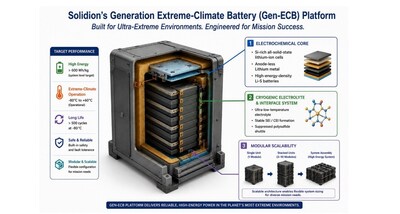
Solidion's Gen-ECB: A Patented Solution for the Extremes of Space
Protected by multiple patents, Solidion's Gen-ECB harnesses the exceptional thermal conductivity and radiation resistance of graphene to actively regulate temperature within battery cells — rapidly dissipating heat to prevent thermal runaway and, when needed, drawing warmth from external sources such as solar panels to maintain stable operations in extreme cold. The result is a battery system proven to operate reliably from −80°C to +60°C, with ongoing development targeting even broader temperature ranges for deep-space missions.
Complementing the Gen-ECB, Solidion's broader battery platform includes silicon-rich all-solid-state lithium-ion cells, anode-less lithium metal, and high-energy-density lithium-sulfur batteries targeting 380+ Wh/kg — delivering dramatically higher energy-to-weight ratios with non-flammable solid electrolytes that are essential for crewed missions where every kilogram and watt counts.
Key Strategic Highlights
- Satellite & LEO AI Data Centers: The Gen-ECB provides extended mission life, increased operational uptime, enhanced satellite endurance, and high-reliability energy storage across the full thermal envelope of orbital operations, addressing one of the fastest-growing segments of the space economy.
- SpaceX Synergies: As Starship targets routine cargo and crew missions to the Moon and Mars, Solidion's batteries offer compact, reliable power for surface operations, energy storage during solar eclipses, and auxiliary systems — far surpassing traditional space batteries in performance and safety.
- NASA Artemis & Lunar Infrastructure: Future Artemis and deep-space exploration missions require rechargeable energy storage capable of surviving prolonged lunar thermal cycles. Solidion is engineering Gen-ECB to deliver high specific energy, lightweight operation, and long-duration reliability for lunar rovers, habitats, and surface power grids — with tested performance exceeding 500 charge cycles at −40°C, a critical durability benchmark for missions that cannot afford a power failure.
- Domestic Supply Chain & IP Strength: With over 385 patents,
U.S .-based green graphite production scaling, and silicon-anode leadership, Solidion supports American space leadership by reducing reliance on foreign battery materials — a critical consideration for national security-oriented space programs.
Jaymes Winters, Chief Executive Officer of Solidion Technology, stated:
"Powering missions in the vacuum of space requires technology that can perform amid intense solar radiation, extreme temperature fluctuations, and the severe vibrations of a launch payload. Solidion's Gen-ECB and advanced battery platforms deliver exactly that — stable, reliable energy storage engineered for the harshest environments humanity has ever operated in. We are actively engaging with aerospace partners to integrate Solidion's technology into next-generation vehicles and infrastructure, positioning our shareholders at the forefront of the multi-planetary future."
Beyond space, Solidion's platform powers electric vehicles, AI data center UPS systems, and aerospace applications — creating diversified revenue streams as the broader space economy and clean energy transition continue to accelerate.
About Solidion Technology, Inc.
Headquartered in Dallas, Texas, with pilot production facilities in Dayton, Ohio, Solidion Technology (NASDAQ: STI) is an advanced battery technology solutions provider focused on manufacturing next-generation battery materials and components, and developing high-performance batteries for energy storage, including UPS systems serving the AI data center market, electric vehicles, and aerospace applications. The Company holds a portfolio of over 385 patents, covering innovations such as high-capacity, silane gas-free and graphene-enabled silicon anodes, biomass-based graphite, and advanced lithium-sulfur and lithium-metal technologies.
For more information, please visit www.solidiontech.com or contact Investor Relations.
Cautionary Note Regarding Forward-Looking Statements
This press release contains forward-looking statements within the meaning of the Private Securities Litigation Reform Act of 1995. Solidion Technology Inc. (NASDAQ: STI) (the "Company," "Solidion," "we," "our" or "us") desires to take advantage of the safe harbor provisions of the Private Securities Litigation Reform Act of 1995 and is including this cautionary statement in connection with this safe harbor legislation. The words "forecasts," "believe," "may," "estimate," "continue," "anticipate," "intend," "should," "plan," "could," "target," "potential," "is likely," "expect," and similar expressions, as they relate to us, are intended to identify forward-looking statements. We undertake no obligation to publicly update any forward-looking statements, whether as a result of new information, future developments, or otherwise, except as may be required by law.

 View original content to download multimedia:https://www.prnewswire.com/news-releases/solidion-technology-unveils-patented-extreme-climate-battery-technology-targeting-low-earth-orbit-based-artificial-intelligence-data-centers-lunar-economy-and-space-302790827.html
SOURCE Solidion Technology, Inc.