STOCK TITAN

Skunk Works®' MDCX™ Controls Boeing MQ-25A™ First Flight

Rhea-AI Impact
(Neutral)
Rhea-AI Sentiment
(Very Positive)
Tags

Lockheed Martin (NYSE:LMT) Skunk Works MDCX platform controlled the first flight of the U.S. Navy's Boeing MQ-25A Stingray on April 22, 2026, from MidAmerica St. Louis Airport.

The MDCX software serves as the ground control component of the Navy's UMCS MD-5 ground control station and was selected for MQ-25A in 2020, demonstrating a ready-now, open-architecture C2 capability for carrier-based unmanned operations.

Loading...
Loading translation...

AI-generated analysis. Not financial advice.

Positive

  • MDCX controlled MQ-25A's first flight on April 22, 2026
  • MDCX is the ground control component of the Navy's UMCS MD-5 GCS
  • MDCX was selected for the MQ-25A program in 2020
  • Open-architecture C2 delivered as a ready-now capability for carrier operations
  • Demonstrated interoperability between Lockheed Martin MDCX and Boeing MQ-25A

Negative

  • None.

News Market Reaction – LMT

-0.02%
1 alert
-0.02% News Effect

On the day this news was published, LMT declined 0.02%, reflecting a mild negative market reaction.

Data tracked by StockTitan Argus on the day of publication.

Market Reality Check

Price: $519.94 Vol: Volume 3,076,325 is 2.17x...
high vol
$519.94 Last Close
Volume Volume 3,076,325 is 2.17x the 20-day average of 1,416,704, indicating elevated trading activity ahead of this news. high
Technical Price at $513.45 trades below the 200-day MA of $523.11, about 25.8% under the 52-week high and 25.2% above the 52-week low.

Peers on Argus

LMT fell 3.08% while key peers GD (-1.14%), NOC (-1.24%), BA (-1.09%), HWM (-0.8...

LMT fell 3.08% while key peers GD (-1.14%), NOC (-1.24%), BA (-1.09%), HWM (-0.81%), and TDG (-0.75%) also traded lower, suggesting broader Aerospace & Defense weakness even though momentum scanners did not flag a sector move.

Common Catalyst BA also reported an MQ-25A test flight, pointing to a shared unmanned aviation milestone across key program partners.

Historical Context

5 past events · Latest: Apr 23 (Positive)
Pattern 5 events
Date Event Sentiment Move Catalyst
Apr 23 Defense partnership win Positive -4.6% Peru’s purchase of 12 F‑16 Block 70 fighters to modernize air force.
Apr 23 Quarterly earnings Negative -4.6% Q1 2026 results with lower profit and reaffirmed full‑year guidance.
Apr 21 Satellite launch Positive -1.6% Launch of GPS III SV10 and transition toward GPS IIIF production.
Apr 14 VC fund expansion Positive -1.3% Increase of Lockheed Martin Ventures capacity to $1 billion for tech investment.
Apr 10 Space mission success Positive +1.0% Orion spacecraft’s successful Artemis II mission and safe crew return.
Pattern Detected

Recent positive program and partnership milestones often coincided with share price weakness, while operational or financial updates have seen mixed reactions.

Recent Company History

Over recent weeks, LMT announced several milestones, including Peru’s selection of 12 F‑16 Block 70 fighters and the launch of GPS III SV10 ahead of 12 GPS IIIF satellites, plus a successful Artemis II Orion return. It also expanded its venture fund capacity from $400 million to $1 billion. Despite these achievements, shares often moved lower after news. Today’s MQ‑25A control milestone fits into this pattern of strong program execution alongside share price pressure following recent earnings and regulatory filings.

Regulatory & Risk Context

Active S-3 Shelf
Shelf Active
Active S-3 Shelf Registration 2026-04-23

An effective S-3ASR shelf dated April 23, 2026 allows LMT to issue unsecured, unsubordinated debt securities in one or more series, with terms such as interest rate and maturity to be set in future prospectus supplements. Stated uses of proceeds are general corporate purposes, including debt repayment, acquisitions, capital expenditures, dividends, and pension funding.

Market Pulse Summary

This announcement highlights MDCX as the command-and-control backbone for the MQ‑25A’s first flight ...
Analysis

This announcement highlights MDCX as the command-and-control backbone for the MQ‑25A’s first flight and for the Navy’s future unmanned carrier aviation operations. It extends a string of recent program milestones across air, space, and defense systems. In evaluating impact, investors may track how such contracts translate into backlog and profitability alongside existing regulatory filings, capital deployment plans, and the flexibility provided by the newly effective S-3ASR debt shelf.

Key Terms

command and control (c2), ground control station, uav, open architecture
4 terms
command and control (c2) technical
"The Lockheed Martin Skunk Works® MDCX™ command and control (C2) platform controlled the first flight"
Command and control (C2) is the remote system or network that attackers use to issue instructions to compromised computers and collect stolen data, like a puppet master controlling infected machines. For investors, evidence of C2 activity signals an active breach that can lead to business disruption, lost customer data, regulatory fines and remediation costs, any of which can hurt revenue, reputation and share value.
ground control station technical
"Mission Control System (UMCS) MD-5 Ground Control Station (GCS)"
A ground control station is the land-based hardware, software and crew that monitor, command and receive data from aircraft, drones, satellites or other remote vehicles. Think of it as the vehicle’s remote control room and radio link—it keeps the asset on course, safe and transmitting useful information. Investors watch ground control systems because they are critical to operational reliability, regulatory approval, maintenance contracts and cybersecurity, which affect revenue and risk.
uav technical
"delivering secure UAV control for its first flight"
An unmanned aerial vehicle (UAV) is an aircraft that flies without a pilot on board, controlled remotely or by onboard software like a self-driving car. Investors care because UAVs are used across industries—delivery, agriculture, inspection, mapping, and defense—so demand, regulation, or technological advances can quickly affect revenue and costs for companies that make, operate, or rely on them. Think of a UAV as a robotic helper in the sky whose growing use can change market opportunities and risks.
open architecture technical
"Our MDCX open architecture C2 solution integrated seamlessly"
Open architecture is a flexible design approach that allows a financial platform or service to include a wide variety of investment options from different providers, rather than being limited to a single company's products. For investors, this means more choices and the ability to customize their investments to better suit their needs, much like a store that offers products from many brands rather than just one.

AI-generated analysis. Not financial advice.

MASCOUTAH, Ill., April 22, 2026 /PRNewswire/ -- The Lockheed Martin Skunk Works® MDCX™ command and control (C2) platform controlled the first flight of the U.S. Navy's MQ‑25A StingrayTM.

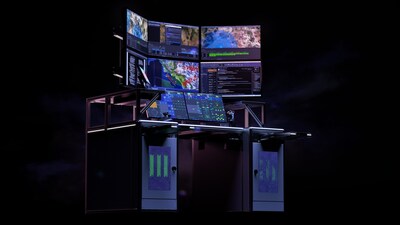
The historic flight, conducted from MidAmerica St. Louis Airport, was controlled by the MDCX software platform, which is the backbone of the Navy's Unmanned Carrier Aviation Mission Control System (UMCS) MD-5 Ground Control Station (GCS). MDCX was selected as the ground control component for Boeing's MQ-25A in 2020.

Why it matters

  • The successful first flight underscores UMCS's ability to command and control the MQ‑25A for the USN and positions MDCX as the foundational C2 platform for the Navy's Air Wing of the Future.

What Our Partners are Saying

  • "Today's successful first flight relied on the seamless integration between a MQ-25 aircraft and Lockheed Martin's ground control station," said Rear Adm. Tony Rossi, who oversees the Program Executive Office for Unmanned Aviation and Strike Weapons.  "This milestone proves the strength of our partnership in developing the command-and-control infrastructure necessary to operate unmanned platforms safely and effectively from our carriers."

A Ready-Now Capability

  • "Our MDCX open architecture C2 solution integrated seamlessly with a Boeing MQ-25A, delivering secure UAV control for its first flight," said OJ Sanchez, vice president and general manager of Skunk Works. "This achievement is a result of our enduring partnership with the U.S. Navy to expand its capabilities and interoperability by enabling a single carrier-based command station to control multiple uncrewed vehicles to advance its Air Wing of the Future vision."

This milestone is the latest proof point of MDCX delivering a ready-now, open-architecture, secure C2 and autonomy capability.

For additional information, visit our website: https://www.lockheedmartin.com/en-us/products/mdcx.html

About Lockheed Martin
Lockheed Martin is a global defense technology company driving innovation and advancing scientific discovery. Our all-domain mission solutions and 21st Century Security® vision accelerate the delivery of transformative technologies to ensure those we serve always stay ahead of ready. More information at Lockheedmartin.com


Cision View original content to download multimedia:https://www.prnewswire.com/news-releases/skunk-works-mdcx-controls-boeing-mq-25a-first-flight-302754358.html

SOURCE Lockheed Martin Aeronautics

FAQ

What did Lockheed Martin (LMT) announce about the MQ-25A first flight?

Lockheed Martin says MDCX controlled the MQ-25A's first flight on April 22, 2026. According to Lockheed Martin, the flight from MidAmerica St. Louis Airport used MDCX as the UMCS MD-5 ground control component, demonstrating carrier-based unmanned command-and-control capability.

How does MDCX fit into the Navy's UMCS and MQ-25A operations (LMT)?

MDCX serves as the ground control component of the Navy's UMCS MD-5 GCS for MQ-25A. According to Lockheed Martin, MDCX provides an open-architecture, secure C2 backbone intended to enable a single carrier station to control multiple uncrewed vehicles.

When was MDCX selected for the Boeing MQ-25A program (LMT)?

Lockheed Martin says MDCX was selected as the MQ-25A ground control component in 2020. According to Lockheed Martin, that selection underpins the recent integration that enabled the MQ-25A's controlled first flight in April 2026.

What does the MQ-25A first flight mean for Lockheed Martin's Skunk Works (LMT)?

The first flight demonstrates MDCX's operational integration with MQ-25A and readiness for carrier use. According to Lockheed Martin, the milestone highlights MDCX's role as a foundational C2 platform supporting the Navy's Air Wing of the Future vision.

Where was the MQ-25A first flight controlled by MDCX conducted (LMT)?

The flight was conducted from MidAmerica St. Louis Airport on April 22, 2026. According to Lockheed Martin, the MDCX platform provided the command-and-control link from the UMCS MD-5 ground control station during that flight.

Does the MDCX integration with MQ-25A indicate a ready-now capability for carriers (LMT)?

Lockheed Martin describes MDCX as a ready-now, open-architecture C2 and autonomy capability for carrier operations. According to Lockheed Martin, the MQ-25A first flight is a proof point of that operational readiness and interoperability with Boeing aircraft.