
Splashdown! Lockheed Martin-Built Orion Spacecraft Safely Returns Astronauts to Earth, Completing NASA's Artemis II Mission
Rhea-AI Summary
Lockheed Martin (NYSE: LMT) announced that the Orion spacecraft safely returned four astronauts to Earth on April 10, 2026, completing NASA's Artemis II mission. The 10-day mission traveled 694,481 miles, set a human distance record of 252,756 miles, and validated Orion systems for future lunar missions.
Orion endured re-entry heat near 5,000°F, deployed parachutes for a Pacific Ocean splashdown, and the crew was recovered to USS John P. Murtha for medical checks. Lockheed Martin remains prime contractor for Orion development.
Positive
- Mission validated Orion for deep space crewed operations
- Spacecraft traveled 694,481 miles round trip
- Set record farthest human spaceflight at 252,756 miles
- Heat shield withstood temperatures nearing 5,000°F during re-entry
- Successful parachute descent and Pacific Ocean splashdown recovery
Negative
- None.
Key Figures
Market Reality Check
Peers on Argus
LMT was down 1.63% while key peers also declined: GD -2.09%, NOC -1.69%, BA -1.15%, HWM -0.27%, TDG -1.13%. The negative move occurred alongside broader Aerospace & Defense softness, suggesting the stock’s dip aligned more with sector pressure than this positive Artemis II milestone.
Historical Context
| Date | Event | Sentiment | Move | Catalyst |
|---|---|---|---|---|
| Apr 01 | Artemis II launch | Positive | +0.8% | Orion spacecraft launched for Artemis II, first crewed lunar vicinity mission in decades. |
| Apr 01 | Earnings webcast notice | Positive | +2.2% | Announcement of upcoming Q1 2026 earnings webcast and disclosure timing. |
| Mar 31 | Rapid Fielding Center | Positive | +1.0% | Opened Rapid Fielding Center to speed prototype development and production timelines. |
| Mar 25 | PrSM production expansion | Positive | +2.3% | Framework to accelerate and quadruple Precision Strike Missile production capacity. |
| Mar 18 | Neuromorphic AI deal | Positive | +0.9% | ForwardEdge ASIC collaboration with BrainChip to integrate neuromorphic AI in ASICs. |
Across recent news, operational and contract announcements have typically coincided with positive next-day price moves.
Over the past month, Lockheed Martin has reported a series of operational and strategic milestones. News on Mar 25 about a framework to quadruple Precision Strike Missile production and a prior $4.94 billion contract saw a 2.3% gain. Facility expansion and innovation updates on Mar 31 and AI-focused collaboration on Mar 18 also drew positive reactions. The Apr 1 Artemis II launch and the Artemis II splashdown both underscore the company’s role in advanced space systems within this broader growth narrative.
Market Pulse Summary
This announcement highlights the successful completion of NASA’s Artemis II mission with the Lockheed Martin‑built Orion spacecraft traveling 694,481 miles and setting a distance record of 252,756 miles from Earth. It validates key systems such as environmental control, life support, and advanced avionics under re-entry temperatures near 5,000°F. In context of other recent contract and capability updates, investors may watch how Artemis outcomes influence future lunar and deep space program awards.
Key Terms
low-Earth orbit technical
free-return trajectory technical
environmental control and life support systems technical
avionics technical
Human Landing System technical
AI-generated analysis. Not financial advice.


First crewed deep space mission in 53 years validates Orion for future lunar exploration
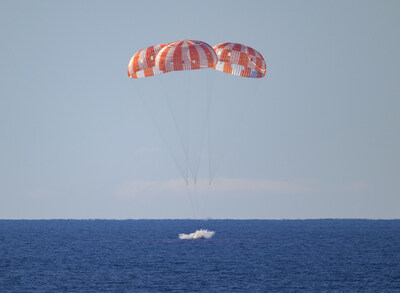
Following a 10-day journey around the Moon, Orion and its four-person crew dramatically re-entered Earth's atmosphere at speeds approaching 24,000 mph before deploying parachutes and splashing down off the coast of southern
"As Orion brings its crew safely home from humanity's first crewed mission to deep space in more than five decades, we've proven what's possible through relentless innovation, discipline, and partnership," said Robert Lightfoot, president of Lockheed Martin Space. "I am incredibly proud of our Lockheed Martin team. This mission validates Orion's performance in the most demanding environment and confirms we are ready to take bold next steps – returning astronauts to the lunar surface."
Orion's Mission: Setting the Stage for Future Exploration
During the mission aboard Orion, astronauts Reid Wiseman, Victor Glover, Christina Koch, and Canadian Space Agency astronaut Jeremy Hansen traveled thousands of miles beyond the far side of the Moon on a free-return trajectory. Along the way, the crew:
- Conducted critical system evaluations, including life support, navigation, communications, propulsion operations and manual piloting
- Captured science imagery and observations of the far side lunar surface
- Tested Orion's fully integrated environmental control and life support systems, as well as advanced avionics and crew interfaces
- Set the record for the farthest human spaceflight from Earth at 252,756 miles
These systems enabled astronauts to live and work in deep space while gathering essential data. The data will be used to refine systems and operations ahead of Artemis III which will demonstrate critical docking with NASA's Human Landing System and Artemis IV, which aims to land astronauts on the Moon for the first time since Apollo.
Orion performed exceptionally well throughout the mission, including its most demanding phase, Earth re-entry. The spacecraft's heat shield withstood temperatures nearing 5,000 degrees Fahrenheit, while its parachute system executed a precise descent sequence to ensure a safe landing.
After splashdown, recovery teams extracted the crew via helicopter and transported them to the USS John P. Murtha recover ship. The astronauts will undergo post-mission medical evaluations before returning to shore and then flying to NASA's Johnson Space Center in
Lockheed Martin is the prime contractor for NASA's Orion spacecraft and has led its design, development, and production. The company continues to work alongside NASA and its partners to enable sustainable lunar exploration and support the agency's long-term goals for human exploration of Mars.
About Lockheed Martin
Lockheed Martin is a global defense technology company driving innovation and advancing scientific discovery. Our all-domain mission solutions and 21st Century Security vision accelerate the delivery of transformative technologies to ensure those we serve always stay ahead of ready. More information at Lockheedmartin.com.

 View original content to download multimedia:https://www.prnewswire.com/news-releases/splashdown-lockheed-martin-built-orion-spacecraft-safely-returns-astronauts-to-earth-completing-nasas-artemis-ii-mission-302739687.html
SOURCE Lockheed Martin