
IBM and Dallara to Advance AI and Quantum-Powered Design for High-Performance Vehicles
Rhea-AI Summary
IBM (NYSE: IBM) and Dallara announced a collaboration on physics-based AI foundation models and exploratory quantum integration to accelerate aerodynamic design for high-performance vehicles on April 30, 2026. Early models trained on Dallara's proprietary CFD data reduced some simulation runs from hours to about 10 seconds.
The teams plan wind‑tunnel and track validation next and published initial results in an arXiv preprint on April 20, 2026.
Positive
- AI surrogate reduced specific CFD evaluations from hours to about 10 seconds
- Early AI matched CFD optimal design with similar error margins
- Collaboration uses Dallara proprietary high‑fidelity aerodynamic simulation data
- Plans to integrate wind‑tunnel and track measurements for validation
Negative
- Wind‑tunnel and on‑track validation are future steps, not yet completed
- Results described as early/preliminary and limited to selected geometry tests
- No financial or commercial terms disclosed in the announcement
News Market Reaction – IBM
In the Apr 30 session, IBM gained 1.71%, reflecting a mild positive market reaction.
Data tracked by StockTitan Argus on the day of publication.
Key Figures
Previous AI Reports
| Date | Event | Sentiment | 24h Move | Catalyst |
|---|---|---|---|---|
| Apr 28 | AI product launch | Positive | +2.2% | Introduced IBM Bob, an AI-first development partner for enterprise SDLC workflows. |
| Apr 21 | AI partnership | Positive | +0.8% | Announced AI-powered experience orchestration solutions in collaboration with Adobe. |
| Apr 16 | AI & quantum research | Positive | +2.5% | Expanded Discovery Accelerator Institute to advance AI and quantum computing research. |
| Mar 31 | AI & quantum alliance | Positive | +2.2% | Launched a 10-year collaboration with ETH Zurich on AI and quantum algorithms. |
| Mar 25 | AI voice integration | Positive | +0.3% | Integrated ElevenLabs speech capabilities into IBM watsonx Orchestrate for agentic AI. |
24h Move is the share-price change in the day after each event; other market factors may also have contributed.
Recent AI-tagged announcements have generally coincided with modest positive next-day moves, averaging about 1.6% across partnerships and research collaborations.
Over the past month, IBM has issued several AI-focused announcements, including the launch of IBM Bob for software development, AI-powered experience orchestration with Adobe, and expanded AI and quantum research with the University of Illinois and ETH Zurich. These AI collaborations typically produced positive 24-hour price reactions between about 0.33% and 2.53%. The new Dallara partnership extends this pattern into high-performance vehicle aerodynamics and hybrid AI–quantum design.
Key Terms
physics-based ai foundation models technical
computational fluid dynamics (cfd) technical
neural surrogate models technical
hybrid quantum-classical technical
gauge-invariant spectral transformers (gist) technical
AI-generated analysis. How Rhea-AI works. Not financial advice.




- IBM and Dallara are collaborating on the development of new physics-based AI foundation models.
- One early model was trained on Dallara's proprietary and validated aerodynamic data of a high-performance vehicle.
- Early results show the potential to reduce aerodynamics simulation time from many hours to few minutes and help engineers explore more design options earlier in vehicle development.
- The companies are starting to explore how to integrate quantum computing in the design workflow and further boost simulation fidelity for complex aerodynamic problems.
For more than 50 years, Dallara has designed and supplied high-performance vehicles for some of the world's top racing series, including IndyCar — where track speeds can average more than 230 mph (370 km/h) — as well as Formula 2, Formula 3, Super Formula, and Indy NXT, with additional work in top-tier series such as Formula E, WEC, and IMSA. This breadth of racing programs provides a unique ability to validate simulation results against real-world vehicle performance. Dallara also applies its engineering to high-performance road vehicles and aerospace. These and other distinctive, innovation-driven features of the company were key in IBM choosing to collaborate with Dallara.
As part of the project, IBM has been developing domain-specific foundation models in close coordination with Dallara. The models leverage not only Dallara's high-fidelity aerodynamic simulation data but also the company's deep technical expertise. In a future step, the teams aim to integrate validated measurements of real vehicles in wind tunnels and on the track, but the use of high-quality simulation data alone is already producing compelling early results.
Engineers rely heavily on computational fluid dynamics (CFD), to predict aerodynamic forces and optimize how vehicles perform across components such as body geometry, underfloor, wings, and wheels. These simulations are powerful but computationally expensive. Even relatively narrow analyses may take a couple of hours or more, while full race car development workflows may take weeks or months as engineers iterate through geometry changes, operating conditions, and performance tradeoffs.
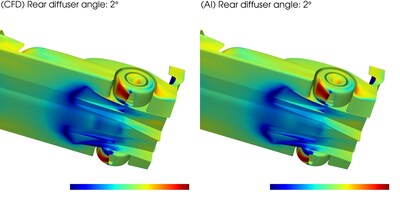
IBM and Dallara are using AI to speed up those workflows without replacing the underlying physics. In one early example, which focused on the geometry of a conceptual Le Mans Prototype 2 (LMP2)-like race car, the two companies jointly compared CFD analyses of multiple configurations of the rear diffuser — a part located in the rear underfloor that helps generate efficient downforce and thus grip — with results from the new physics-based AI method.
The traditional approach took a few hours to calculate all the configurations. Meanwhile, the AI model completed the same evaluations in about 10 seconds, identifying the same optimal design with roughly the same error margins as CFD. Applied to a typical complete set of hundreds of geometry configurations, such a speedup could cut days of simulation time down to minutes.
These and other preliminary results suggest Dallara engineers can evaluate more vehicle configurations in a fraction of time to move faster in early design phases, helping focus their most expensive computational resources on deep-dive optimization of race car design and development.
In parallel, IBM and Dallara are starting to explore how quantum and hybrid quantum-classical approaches could further enhance race car design workflows. By combining Dallara's expertise in high-fidelity vehicle engineering and CFD-driven design with IBM's leadership in quantum computing and AI, the collaboration will evaluate where these methods can complement traditional simulation workflows in the near-term while identifying longer-term opportunities for practical use in automotive and motorsport design.
"Racing has taught Dallara that there are two possible outcomes: you either win or are forced to learn. IBM's close collaboration on this innovative project is a testament of Dallara's willingness to continuously push its boundaries and never stop learning," said Andrea Pontremoli, Dallara CEO.
"Some of the hardest engineering challenges come down to accurately simulating the physical world," said Alessandro Curioni, IBM Fellow and VP, Algorithms and Applications, IBM Research. "With Dallara, IBM is applying AI to speed up aerodynamic design today while advancing quantum computing in parallel to push simulation farther. Together, these technologies can help engineers move faster, explore more possibilities, and ultimately design better-performing vehicles."
Advancing aerodynamic design with AI
Designing a high-performance vehicle means balancing downforce, drag, stability, and responsiveness across conditions that can change from race to race. Because some parts are designed with exacting precision, even small design changes can lead to surprisingly large impacts on performance, and the best aerodynamic solution is not always obvious.
The AI models are being designed to help predict aerodynamic behaviors directly from geometry and related engineering inputs. As the collaboration progresses, IBM and Dallara plan to expand the AI models across a wider range of conditions, such as different maneuvers or overtaking scenarios, apply them to design new vehicles and develop tools that enable faster exploration of new aerodynamic configurations, before investing in intensive full-vehicle simulations.
"High-performance vehicles are an ideal proving ground for neural surrogate models, but the potential impact goes well beyond the racetrack," said Fabrizio Arbucci, Dallara CIO. "More efficient designs could benefit all transport categories, from passenger vehicles to aircraft, and even other industries at the mercy of aerodynamics. Even a one to two percent reduction in drag across passenger vehicles could add up to meaningful fuel-efficiency gains at scale."
Initial results of the collaboration are detailed in a preprint study published at arXiv on April 20, 2026. This work builds upon a new AI model developed by IBM, called Gauge-Invariant Spectral Transformers (GIST), which was described in a March 17th preprint study. IBM and Dallara presented these and other advances in applying AI to complex physical systems on April 26, 2026, at the International Conference on Learning Representations in
About IBM
IBM is a leading provider of global hybrid cloud and AI, and consulting expertise. IBM helps clients in more than 175 countries capitalize on insights from their data, streamline business processes, reduce costs and gain the competitive edge in their industries. Thousands of governments and corporate entities in critical infrastructure areas such as financial services, telecommunications and healthcare rely on IBM's hybrid cloud platform and Red Hat OpenShift to affect their digital transformations quickly, efficiently and securely. IBM's breakthrough innovations in AI, quantum computing, industry-specific cloud solutions and consulting deliver open and flexible options to our clients. All of this is backed by IBM's long-standing commitment to trust, transparency, responsibility, inclusivity and service. Visit www.ibm.com for more information.
About The Dallara Group
Founded in 1972 by Giampaolo Dallara, Dallara is a world-leading manufacturer specializing in the design, engineering, and production of racing cars for top-tier motorsports. The firm has expanded globally from
Media Contacts
IBM Research
Dave Mosher
IBM Research Communications
dave.mosher@ibm.com
Ashley Peterson
IBM Research Communications
ashley.peterson@ibm.com
Dallara
Andrea Vecchi
Dallara Marketing & Communications Director
a.vecchi@dallara.it
 View original content to download multimedia:https://www.prnewswire.com/news-releases/ibm-and-dallara-to-advance-ai-and-quantum-powered-design-for-high-performance-vehicles-302758105.html
SOURCE IBM