
AI Data Center Growth Hinges on Solving Both Power Constraints and Community Concerns, Bloom Energy Report Finds
Key Terms
carbon capture technical
high-density architectures technical
rack-level dc designs technical
hyperscalers technical
colocation providers technical
double-blind process technical


- Developers expect continued data center expansion through 2030 as AI adoption accelerates.
-
Access to power remains the biggest challenge to growth, with
61% of developers planning to bring their own power if the grid cannot meet their needs - Community scrutiny has become a growing barrier, driven by concerns over electricity prices, water consumption and grid reliability
Key findings from the report include:
-
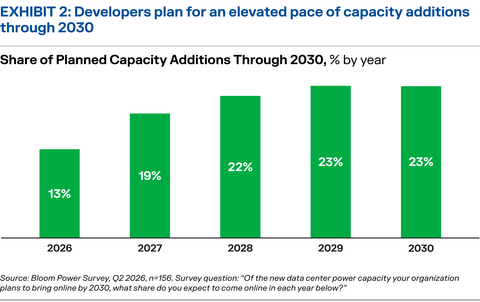
Developers are planning significant capacity additions through the end of the decade as AI adoption accelerates. Inference now accounts for more than
50% of AI compute, reflecting the transition from model building to real-world applications, with inference driving sustained demand for new data center capacity. -
Access to power remains the dominant issue for data center development, with
61% of developers planning to bring their own power if the grid is unavailable. -
New barriers are affecting the buildout of large-scale projects, impacting the pace of execution: Community scrutiny has intensified over the past six months, with developers citing higher electricity prices, increased water consumption, and strain on grid reliability as the concerns most likely to influence projects. As of May 2026, at least 18 state bills and 86 local moratoriums have been proposed across the
U.S . - Carbon capture is moving from concept to deployment: Nearly one-third of onsite-powered sites are expected to incorporate carbon capture by 2030, reflecting growing pressure to address emissions concerns while expanding power capacity.
- A readiness gap risks slowing AI innovation: Chip developers expect high-density architectures and rack-level DC designs to be adopted in 2028, a full year ahead of data center developers’ plans, highlighting a growing readiness challenge as AI hardware requirements evolve.
“Access to power remains the biggest constraint to data center growth, but it is not the only issue. Community concerns are increasingly shaping which projects move forward,” said Natalie Sunderland, Chief Marketing Officer at Bloom Energy. “Our findings suggest that solutions that reduce strain on local infrastructure while helping developers bring new capacity online faster—such as clean onsite power—will play an important role. We believe the winners in the next phase of AI buildout will be those that can grow in a way that works for both operators and the communities that host them.”
The 2026 Bloom Energy Data Center Power Report Mid-Year Pulse is based on surveys commissioned via a double-blind process between Bloom Energy and respondents. Surveys were conducted in April 2026 among 156 decision-makers across the data center ecosystem, reflecting perspectives from hyperscalers, colocation providers, neoclouds, data center developers, chip developers, with
About Bloom Energy
Bloom Energy empowers enterprises to meet soaring energy demands and responsibly take charge of their power needs. The company’s fuel cell systems provide ultra-resilient, clean, and highly scalable onsite electricity for Fortune 500 customers around the world, including data centers, semiconductor manufacturing, large utilities, and other commercial and industrial sectors as well as mission-critical organizations in local communities, such as hospitals, college campuses and retailers. Headquartered in Silicon Valley, Bloom Energy employs more than 2,000 people worldwide and manufactures its systems in the United States. For more information, visit BloomEnergy.com.
Forward Looking Statements
This press release contains certain forward-looking statements, which are subject to the safe harbor provisions of the Private Securities Litigation Reform Act of 1995. Forward-looking statements generally relate to future events or our future financial or operating performance. In some cases, you can identify forward-looking statements because they contain words such as “anticipate,” “believe,” “could,” “estimate,” “expect,” “intend,” “may,” “should,” “will” and “would” or the negative of these words or similar terms or expressions that concern Bloom’s expectations, strategy, priorities, plans, or intentions. These forward-looking statements include, but are not limited to, the intentions of developers with respect to their plans to power data centers, the expected growth of data center electricity demand, the pace of data center capacity additions, the composition of AI demand between data center training and inference workloads, key buying and decision factors for data center site selection, barriers to data center development and issues driving community scrutiny of new data centers, strategies utilized by data center developers to engage with communities, share of data centers expected to incorporate carbon capture, utilization, and storage, and expected adoption timeline of next-generation architectures. Readers are cautioned that these forward-looking statements are only predictions and may differ materially from actual future events or results due to a variety of factors, including, but not limited to, risks and uncertainties detailed in Bloom’s SEC filings. More information on potential risks and uncertainties that may impact Bloom’s business are set forth in Bloom’s periodic reports filed with the SEC, including its Annual Report on Form 10-K for the year ended December 31, 2025, filed with the SEC on February 9, 2026, its Quarterly Report on Form 10-Q for the quarter ended March 31, 2026, filed with the SEC on April 29, 2026, as well as subsequent reports filed with or furnished to the SEC. Bloom assumes no obligation to, and does not intend to, update any such forward-looking statements.
View source version on businesswire.com: https://www.businesswire.com/news/home/20260615003193/en/
Media
Bloom Energy – Katja Gagen (press@bloomenergy.com)
Investors
Bloom Energy – Michael Tierney (investor@bloomenergy.com)
Source: Bloom Energy