Future Long Range Assault Aircraft Officially Named MV-75 Cheyenne II
Future Long Range Assault Aircraft Officially Named MV-75 Cheyenne II
Rhea-AI Impact
(Moderate)
Rhea-AI Sentiment
(Neutral)
Tags
Key Terms
multi-mission vertical takeofftechnical
A multi-mission vertical takeoff vehicle is an aircraft or spacecraft designed to lift off and land straight up or down and to perform more than one type of job—such as cargo delivery, passenger transport, surveillance, or emergency response—without major redesign. For investors it matters because a versatile platform can reach more customers, spread development costs across multiple markets, and potentially generate steadier revenue, but it can also face higher technical complexity, certification hurdles, and market adoption risk.
modular open systems approachtechnical
A modular open systems approach is a way of designing products so parts can be mixed, matched and upgraded independently, often using shared standards that allow different suppliers to provide compatible components. For investors it matters because this reduces vendor lock-in, speeds product upgrades, lowers long‑term costs and can expand the pool of suppliers, all of which can improve a company’s flexibility, revenue potential and resilience to supply disruptions—think of it like building with LEGO blocks instead of fixed, one‑piece toys.
long-range air assaulttechnical
A long-range air assault is a military operation in which aircraft—such as bombers, attack helicopters, or armed drones—strike or seize targets far from friendly bases, often projecting force deep into another area. For investors, it signals potential shifts in defense spending, contract demand, geopolitical risk and supply-chain disruption; think of it like a distant delivery or blockade that can change who gets paid, how goods move, and how markets price risk.
army contracting commandregulatory
A military contracting command is the organization within an army that buys goods and services—everything from uniforms and vehicles to technology and construction—by issuing and managing contracts with private companies. For investors, it matters because this office controls which suppliers win work, the size and timing of payment flows, and contract rules that affect revenue predictability and compliance risk for defense contractors; think of it as the army’s purchasing and contract manager.
NASHVILLE, Tenn.--(BUSINESS WIRE)--
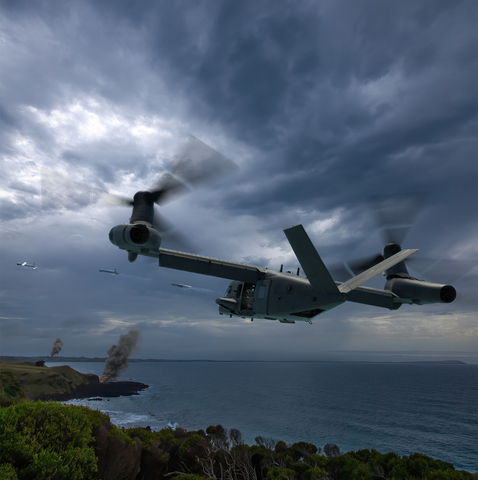
Bell Textron Inc., a Textron Inc. (NYSE: TXT) company, announced today that the U.S. Army officially designated the MV-75 as the Cheyenne II. Consistent with the U.S. Army tradition of honoring Native American tribes, the MV-75 honors the heritage of the Cheyenne Tribes, two federally recognized nations: the Northern Cheyenne Tribe in Montana and the Cheyenne & Arapaho Tribes in Oklahoma.
Photo by: Bell
In 2025, the Army revealed the Mission Design Series (MDS) MV-75. The “MV” signals that it is a multi-mission vertical takeoff aircraft and the “75” commemorates the U.S. Army’s founding year, 1775. While the MDS honors the Army’s origin, the common name, Cheyenne II, honors the Cheyenne Tribes and their enduring legacy.
“In naming the MV-75 Cheyenne II, we honor the enduring contributions of the Cheyenne people to our Nation - both their distinguished service in uniform and their legacy as steadfast protectors of their way of life,” said COL Jeffrey Poquette, Project Manager, FLRAA. “The name also reflects a connection to the bold vision of the AH-56 Cheyenne, while ‘II’ signifies a new era of innovation and capability. It is a name that pays tribute to an indomitable warrior spirit and signals a decisive step forward for Army aviation.”
Throughout their history, the Cheyenne demonstrated remarkable adaptability, resilience, and determination in the face of shifting environments and external pressures. As the Cheyenne relocated multiple times due to threats from rival nations and westward expansion, they developed new skills, reorganized their communities, and remained agile in rapidly changing conditions.
The MV-75 Cheyenne II reflects these same qualities. With its speed, range, lethality, and multi-mission adaptability, the Cheyenne II provides commanders with rapid options to mass combat power while reducing exposure in contested environments. Its Modular Open Systems Approach (MOSA) ensures the platform can evolve with the demands of the modern battlefield.
The Cheyenne developed a strong warrior ethos defined by courage, discipline, and an unwavering commitment to protecting their people. Their warriors were celebrated for strength, endurance, and steadfastness in harsh conditions. The MV-75 Cheyenne II brings increased lethality to the Army, enabling commanders to have more options against adversaries to overwhelm them in battle. Its endurance enables the Army to operate at vast distances outside of the densest threat rings. A capability unavailable to them with current rotorcraft.
With its new name, the MV-75 represents two distinct groups of warriors - the U.S. Army and the Cheyenne tribes. Both share a heritage of skill, confidence, and commitment to the mission. The MV-75 Cheyenne II embodies these values as it becomes the centerpiece of the Army’s long-range air assault mission.
“Bell is proud that the MV-75 carries the name of the Cheyenne Tribes as we revolutionize Army Aviation. The Cheyenne heritage represents everything that the MV-75 will bring to the future fight,” said Ryan Ehinger, senior vice president & program director, FLRAA, Bell. “This is a significant milestone that comes right as we are accelerating assembly and production to deliver the MV-75 capability to warfighters faster.”
Bell and the Army remain on schedule as the team advances toward the delivery of the first test aircraft. Assigning an official name demonstrates the shared commitment to fieldling this critical next generation capability.
The MV-75 Cheyenne II is a transformational capability for the U.S. Army. With today’s naming announcement, Bell and the Army are one step closer to introducing the next generation of Army Aviation to the battlefield.
This material is based upon work supported by the Army Contracting Command - Redstone Arsenal under Contract No. W58RGZ-23-C-0001. Any opinions, findings and conclusions or recommendations expressed in this material are those of the author(s) and do not necessarily reflect the views of the Army Contracting Command - Redstone Arsenal.
ABOUT BELL
Thinking above and beyond is what we do. For more than 90 years, we’ve been reimagining the experience of flight – and where it can take us. We're an aerospace and defense company that engineers and manufactures aircraft for critical solutions in extreme scenarios. We're breaking barriers in lifting people to safety across transportation, medical, rescue and military services, and leading the industry in future solutions that are fast, reliable and efficient. Headquartered in Fort Worth, Texas – as a wholly-owned subsidiary of Textron Inc., – we have strategic locations around the globe. And with nearly one quarter of our workforce having served, helping our military achieve their missions is a passion of ours. Above all, our breakthrough innovations deliver exceptional experiences to our customers. Efficiently. Reliably. And always, with safety at the forefront.
ABOUT TEXTRON
Textron Inc. is a multi-industry company that leverages its global network of aircraft, defense, industrial and finance businesses to provide customers with innovative solutions and services. Textron is known around the world for its powerful brands such as Bell, Cessna, Beechcraft, Pipistrel, Jacobsen, Kautex, Lycoming, E-Z-GO, and Textron Systems. For more information, visit: www.textron.com.
Certain statements in this press release may project revenues or describe strategies, goals, outlook or other non-historical matters; these forward-looking statements speak only as of the date on which they are made, and we undertake no obligation to update them. These statements are subject to known and unknown risks, uncertainties, and other factors that may cause our actual results to differ materially from those expressed or implied by such forward-looking statements, including, but not limited to, the risk that the U.S. Army does not choose Bell for its Flight School Next program and risks related to U.S. Government contracts as described in our filings with the Securities and Exchange Commission