Free ad-supported TV (FAST) are streaming channels and apps that deliver full-length TV shows and movies over the internet at no charge to viewers, with revenue generated from commercials. Think of it as traditional broadcast TV moved online — easy to access like a free radio station but with video — and it matters to investors because audience size, viewing time and ad rates drive steady, scalable income and can signal growth in a lower-cost customer base compared with paid subscriptions.
linux-basedtechnical
Software described as "linux-based" runs on the Linux operating system, the underlying program that controls computers, servers or smart devices — think of it as the engine that makes hardware work. For investors, this matters because Linux often means lower software costs, wide compatibility, strong security and easier customization, which can reduce expenses, speed product development and influence a company’s competitive edge and margins.
web-app architecturestechnical
Web-app architectures are the design blueprints that determine how a website or online service is built, how its pieces communicate, and where data and code live. Like a building’s floor plan and plumbing, the architecture affects speed, reliability, security, and how easily the site can grow or be fixed—factors that directly influence operating costs, user satisfaction, and the potential for revenue growth, all key concerns for investors.
android appstechnical
Android apps are software programs built to run on devices using the Android operating system, like many smartphones and tablets. For investors they matter because they are the primary way companies reach users, generate revenue through sales, subscriptions, or ads, and gather data; the number of users, engagement levels, and platform rules can strongly affect a business’s growth and risk profile, much like a storefront’s foot traffic and rent terms.
user experience (ux)technical
The user experience (UX) is the overall impression and ease people have when interacting with a product, website, app, or service—how simple it feels, how fast it works, and whether it leaves a positive impression. For investors, UX matters because it directly affects how many customers sign up, keep using a product, or recommend it to others; a well-designed experience can boost revenue, lower support and marketing costs, and strengthen a company’s competitive edge.
generative aitechnical
Generative AI is a type of computer technology that can create new content, like text, images, or music, on its own. It’s important because it can produce realistic and useful material quickly, which could change how we create art, write stories, or even develop new products. Think of it as a smart robot that can invent and produce things almost like a human.
aitechnical
Artificial intelligence (AI) is technology that enables machines to mimic human thinking and learning, allowing them to analyze information, recognize patterns, and make decisions. For investors, AI matters because it can improve how businesses operate, create new products, or identify opportunities faster and more accurately than humans alone, potentially impacting company success and market trends.
See more from StockTitan in Google Search and AI answers.Adds StockTitan as a preferred source · opens Google
LONDON--(BUSINESS WIRE)--
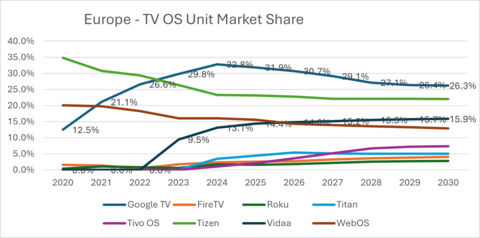
TV Operating Systems that did not exist in 2022 are forecast to control 28% of the European TV operating system (OS) market by 2030, up from 21% in 2025, according to Omdia’s latest TV Design & Features Tracker. This rapid shift underscores how TV brands are increasingly prioritizing advertising revenue from the TV OS over traditional hardware revenue.
Europe - TV OS Unit Market Share
In Europe, Google TV currently leads with a 32% share but will lose share gradually to three key competitors: VIDAA, Titan OS and TiVo. These three platforms represent a growing group of independent operating systems that are successfully challenging Google TV in Europe.
Independent TV OS Revenue-Sharing Models
While these platforms differ in their origins, they share a common business philosophy that is highly attractive to European TV manufacturers seeking to protect their profit margins and brand identity.
Unlike Google TV, which largely keeps advertising and data revenue within the Google ecosystem, VIDAA, Titan OS, and TiVo offer active revenue-sharing models. This allows TV brands to earn a continuous stream of income from home-screen ads and FAST (Free Ad-Supported TV) channels long after the initial hardware sale.
All three systems are primarily Linux-based and utilize web-app architectures rather than native Android apps. This makes them significantly lighter and faster, often requiring less powerful, and more cost-effective hardware to run smoothly compared to the more resource-heavy Google TV. This is especially important in 2026, as memory prices have spiked over the last year. The European TV market is highly competitive with slim hardware margins. Adopting a lean OS allows manufacturers to use more affordable processors while still delivering a responsive, 4K-capable interface that avoids the lag often seen in entry-level TV sets.
Controlling Smart TV User Experience and European Content
These platforms provide TV manufacturers with greater control over the User Experience (UX) and viewer data. While Google TV enforces a strict, standardized look and keeps viewer insights for its own ad engine, these independent players allow brands like Philips (Titan) and Hisense (VIDAA) to maintain a distinct brand feel and access their own audience analytics.
Titan OS, being European-built, and TiVo have focused heavily on integrating local European broadcasters into a unified homepage. This content-first approach combines live TV and streaming more seamlessly and resonates better with traditional European viewing habits.
Titan OS and TiVo recently formed a strategic ad-sales partnership in Europe. This gives them the collective ad reach needed to attract major European advertisers, making their revenue-sharing promises more realistic for TV brands
Omdia projects that Europe will reach an inflection point in 2028, when combined shipments of VIDAA, Titan OS and TiVo reach 11.9 million units. 57% of this total volume is expected to be driven by Hisense and the rapid expansion of its VIDAA platform. By 2030, Omdia forecasts that VIDAA will reach 18.0 million units globally, with Europe accounting for 7.0 million units.
“At CES 2026, VIDAA OS underwent a major transformation,” said Patrick Horner, Practice Leader, TV Set Research, Omdia. “The operating system is transitioning to a new name, V Home OS, to reflect its broader role beyond just televisions. A significant partnership with Microsoft was announced to integrate Copilot’s generative AI capabilities directly into the platform, enhancing the user experience with advanced AI services. The name change is part of the wider push by the company to position the platform to be an operating system that encompasses not only AI but also, eventually, acts as a shopping portal.”
ABOUT OMDIA
Omdia, part of TechTarget, Inc. d/b/a Informa TechTarget (Nasdaq: TTGT), is a technology research and advisory group. Our deep knowledge of tech markets grounded in real conversations with industry leaders and hundreds of thousands of data points, make our market intelligence our clients’ strategic advantage. From R&D to ROI, we identify the greatest opportunities and move the industry forward.