
75% of Americans say they would lose trust in AI shopping if results were sponsored
Rhea-AI Summary
Quad (NYSE: QUAD) and The Harris Poll survey finds widespread consumer distrust of paid influence in AI shopping: 75% of Americans would trust AI shopping less if results were sponsored. Awareness of agentic AI shopping is 74%, and only 39% trust AI to make everyday purchases.
The online survey of 2,180 U.S. adults was conducted Feb 5–7, 2026, and highlights stronger trust in physical stores (81% cite in-store experience boosting confidence) and major concerns about data use and personalized pricing.
Positive
- AI awareness at 74% of Americans
- In-store trust: 81% say great in-store experience increases online trial confidence
- AI utility: Two in three shoppers use AI to spot pricing inconsistencies
Negative
- Trust risk: 75% would trust AI shopping less if recommendations were sponsored
- Data unease: 73% feel uneasy about how AI might use personal shopping data
- Low purchase confidence: Only 39% trust AI to make everyday purchases
News Market Reaction – QUAD
In the Apr 13 session, QUAD gained 0.28%, reflecting a mild positive market reaction.
Data tracked by StockTitan Argus on the day of publication.
AI-generated analysis. How Rhea-AI works. Not financial advice.




Consumers increasingly tap agentic AI to shop, but brand trust remains strongest in physical stores
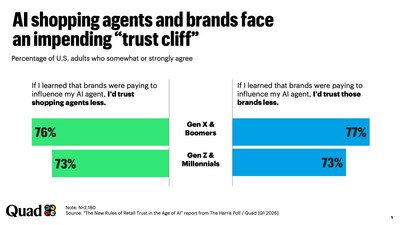
"The New Rules of Retail Trust in the Age of AI" survey, a continuation of the 2025 "Return of Touch" report, indicates that price-conscious consumers are using AI for convenience and to reduce uncertainty in a rapidly changing shopping landscape but still have concerns about trust and data transparency. According to the research, shoppers continue to have high confidence in in-store experiences, especially regarding item quality and pricing.
"Consumers are scrutinizing value more closely and questioning who, or what, is shaping their purchase decisions," said Heidi Waldusky, Quad's Vice President of Brand and Integrated Marketing. "AI offers real promise for efficiency and personalized service to make life easier, but any hint that AI shopping is quietly steering users toward paid influence could confirm a fear that the system isn't on our side."
Shoppers want help, not hype
In today's complex shopping landscape, consumers are drawn to AI shopping agents for practical reasons, expressing strong interest in capabilities that promote convenience, simplify decision-making and reduce uncertainty.
74% of Americans are now aware of agentic AI shopping technology.51% of consumers (62% of Gen Z and Millennials) say they would rather use AI-powered shopping tools to reduce the risk of making a bad purchase.- Two in three shoppers use AI for spotting pricing inconsistencies, while three in five say AI helps them stay on budget and helps narrow choices faster.
Trust is at risk amid high consumer caution and skepticism
As AI platforms explore monetization models, consumers signal that incorporating paid ads risks eroding trust in both brands and the AI platforms themselves. In the survey,
The insight correlates with findings that shoppers are more aware of how technology influences the shopping experience.
- When it comes to digital shopping,
73% of Americans report that algorithm-driven pricing makes it hard to know if they are getting the best deal. - Most Americans (
54% ) find allowing AI access to their shopping history unappealing, and73% feel uneasy about how AI might use personal shopping data. - Being an informed shopper is more important today than it was 12 months ago for nearly three-quarters (
73% ) of consumers.
Even as interest in AI shopping catches on, consumer trust in AI purchasing lags. Only
"The opportunity for brands is to build brand trust through their physical stores and products, while seamlessly and transparently integrating the AI technology in a way that makes those IRL spaces and experiences better for shoppers," Waldusky continued.
Balancing the trust equation: In-store experiences in an AI-enabled world
While AI trust is in a precarious place, the survey shows that physical retail remains a powerful trust asset over which brands have more control. Consumers report a preference for physical stores that allow for in-person product verification, visible price consistency and social connection.
81% of Americans say a great in-store experience with a brand makes them more confident trying new products from that brand online.81% agree that it is easier for brands to misrepresent product quality online than it is in-store.71% of respondents note that personalized online pricing (e.g., "surveillance pricing") makes them want to shop in stores, where everyone pays the same price.- Younger consumers are more likely to actively use AI tools during shopping experiences, with majorities of Gen Z (
52% ) and Millennials (55% ) saying they use AI in store for real-time help (compared to39% overall). - A perhaps surprising number of consumers —
60% of Millennials,54% of Gen Z, and45% of all Americans — expressed more faith in AI-powered shopping tools than in-store associates to provide unbiased recommendations.
"The real competitive question for physical retail isn't whether a human can out-personalize an algorithm. It's whether a store can create an experience compelling enough to earn the visit," said Libby Rodney, Chief Strategy Officer, The Harris Poll. "We see in our data that nearly half of Gen Z are already willing to use an AI agent to help shop for clothing, so personalization is a baseline expectation. The stores that win will be the ones worth showing up to and smart enough to let AI take it from there."
The "The New Rules of Retail Trust in the Age of AI" report was conducted online within
Access the press kit here.
About Quad
Quad (NYSE: QUAD) is a marketing experience, or MX, company that helps brands make direct consumer connections, from household to in-store to online. The company does this through its MX Solutions Suite, a comprehensive range of marketing and print services that seamlessly integrate creative, production and media solutions across online and offline channels. Supported by state-of-the-art technology and data-driven intelligence, Quad simplifies the complexities of marketing by removing friction wherever it occurs along the marketing journey. The company tailors its uniquely flexible, scalable and connected solutions to each client's objectives, driving cost efficiencies, improving speed-to-market, strengthening marketing effectiveness and delivering value on client investments.
Quad employs approximately 10,000 people in 10 countries and serves approximately 2,100 clients including industry leading blue-chip companies that serve both businesses and consumers in multiple industry verticals, with a particular focus on commerce, including retail, consumer packaged goods, and direct-to-consumer; financial services; and health. Quad is ranked among the largest agency companies in the
For more information about Quad, including its commitment to operating responsibly, intentional innovation and values-driven culture, visit quad.com.
About The Harris Poll
The Harris Poll is one of the longest-running surveys in the
Media Contact
Sarah Mikhailova
Manager, Media Relations
212-672-1319
sumikhailova@quad.com

 View original content to download multimedia:https://www.prnewswire.com/news-releases/75-of-americans-say-they-would-lose-trust-in-ai-shopping-if-results-were-sponsored-302739901.html
SOURCE Quad