
PyroGenesis Delivers New Technology to Convert Contaminated Biomass to Syngas
Rhea-AI Summary
PyroGenesis (OTCQX: PYRGF) announced delivery of a high-temperature gasification system that converts contaminated biomass into synthesis gas (syngas) for client Innofibre at its new $14 million pilot and pre-commercial facility in Trois-Rivières, Quebec.
The centre, described as unique in North America for mimicking industrial conditions, targets forest and agricultural biomass applications, including bio-based products, waste valorization, biochar, decarbonization, and tailings recovery. PyroGenesis’ plasma-based waste-to-energy technology treats contaminants in biomass-derived syngas, which can be used for power generation or as a feedstock for chemicals, fertilizers, methanol, ammonia, and synthetic fuels.
AI-generated analysis. Not financial advice.
Positive
- PyroGenesis system selected for Innofibre’s new $14 million pilot facility
- Technology converts contaminated biomass to syngas suitable for multiple downstream uses
- Participation in a North American facility designed to mimic industrial production conditions
- Project aligns with decarbonization and biomass waste valorization efforts
Negative
- None.
News Market Reaction – PYRGF
On the day this news was published, PYRGF gained 2.34%, reflecting a moderate positive market reaction.
Data tracked by StockTitan Argus on the day of publication.


Technology to debut at Innofibre’s newly launched research & pilot stage facility
MONTREAL, June 17, 2026 (GLOBE NEWSWIRE) -- PyroGenesis Inc. (“PyroGenesis” or the “Company”) (TSX: PYR) (OTCQX: PYRGF) (FRA: 8PY1), a leader in ultra-high temperature processes and engineering innovation, and a plasma-based technology provider to heavy industry & defense, announces today a collaborative project to convert contaminated biomass into syngas with its client Innofibre – Centre d’innovation des produits cellulosiques, a CCTT (“College Centre for the Transfer of Technologies”) at the Cégep de Trois-Rivières. The CCTT is focused on the paper and biorefining industry in Quebec.
PyroGenesis’ technology was included during the launch of Innofibre’s new
The official opening of the facility included speeches by Jean Boulet, Quebec’s Minister of Labour and MNA for Trois-Rivières, representatives from funding partners Canada Economic Development and the Fonds du Grand Mouvement Desjardins, and Jean-Philippe Jacques, General Manager of Innofibre. Attending for PyroGenesis were Jean-René Gagnon, Director of Engineering, Jenosan Annamalai, Process Engineer, and Yves Bilien, Project Manager for High-Temperature Processes and Thermal Plasma.
The system delivered by PyroGenesis will convert contaminated biomass to synthesis gas (syngas). Biomass is organic material from plants and animals, with the plant materials including wood chips, pellets, firewood, and agricultural residues. Biomass-derived syngas reduces dependence on fossil fuels while supporting decarbonization efforts and the achievement of global climate objectives. The inclusion and successful treatment of contaminated biomass increases the overall amount of biomass feedstock available for syngas production. Contaminated biomass can contain paint, solvents, and a variety of other chemicals and materials such as melamine that can get mixed into biomass in landfills or were added to wood products during manufacturing and prior to being recycled. PyroGenesis’ high temperature waste-to-energy gasification technology allows for the treatment of contaminants in the produced syngas. The syngas can be used to generate electricity or in the production of a variety of products, including chemicals and fertilizers, methanol, ammonia, synthetic fuels such as renewable diesel and gasoline, and others.
“Congratulations to the Innofibre team on the opening of their important new facility,” said Mr. P. Peter Pascali, President and CEO of PyroGenesis. “This centre of excellence is vital to the commercialization of Quebec-based innovations for the bioeconomy, decarbonization, and forestry sectors. We look forward to a continued partnership with Innofibre to help bring new technologies and products to global markets, while also helping to make a greener economy.”
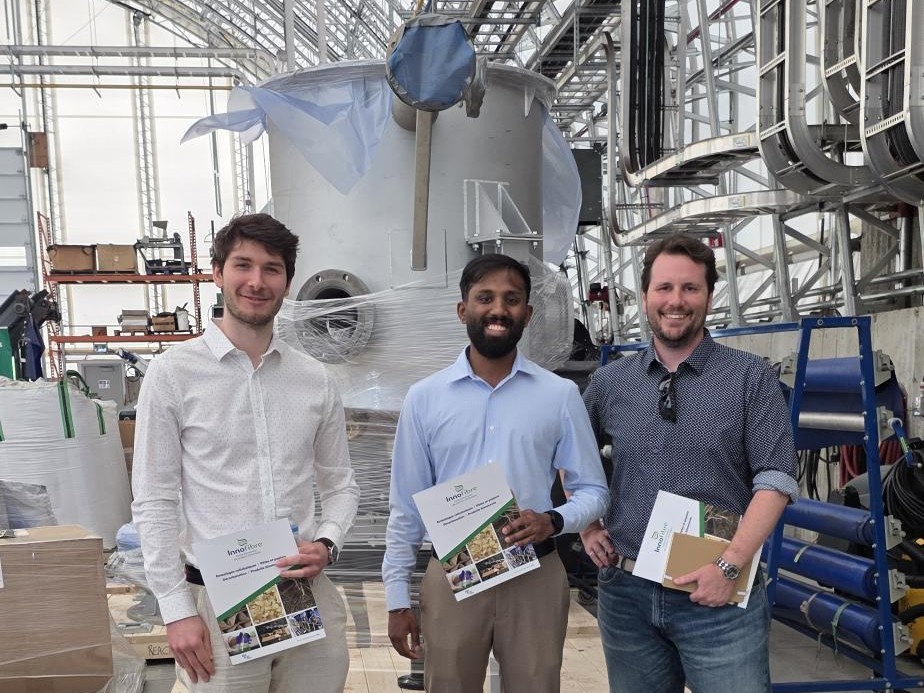
Image: PyroGenesis’ engineering team representatives: Yves Bilien, Jenosan Annamalai, and Jean-René Gagnon, stand in front of PyroGenesis’ new technology for converting contaminated biomass into syngas, at the official opening of Innofibre’s new
About PyroGenesis Inc.
PyroGenesis leverages 35 years of plasma technology leadership to deliver advanced engineering solutions to energy, propulsion, destruction, process heating, emissions, and materials development challenges across heavy industry and defense. Its customers include global leaders in aluminum, aerospace, steel, iron ore, utilities, environmental services, military, and government. From its Montreal headquarters and local manufacturing facilities, PyroGenesis’ engineers, scientists, and technicians drive innovation and commercialization of energy transition and ultra-high temperature technology. PyroGenesis’ operations are ISO 9001:2015 and AS9100D certified, with ISO certification maintained since 1997. PyroGenesis’ shares trade on the TSX (PYR), OTCQX (PYRGF), and Frankfurt (8PY1) stock exchanges.
Cautionary and Forward-Looking Statements
This press release contains “forward-looking information” and “forward-looking statements” (collectively, “forward-looking statements”) within the meaning of applicable securities laws. In some cases, but not necessarily in all cases, forward-looking statements can be identified by the use of forward-looking terminology such as “plans”, “targets”, “expects” or “does not expect”, “is expected”, “an opportunity exists”, “is positioned”, “estimates”, “intends”, “assumes”, “anticipates” or “does not anticipate” or “believes”, or variations of such words and phrases or state that certain actions, events or results “may”, “could”, “would”, “might”, “will” or “will be taken”, “occur” or “be achieved”. In addition, any statements that refer to expectations, projections or other characterizations of future events or circumstances contain forward-looking statements. Forward-looking statements are not historical facts, nor guarantees or assurances of future performance but instead represent management’s current beliefs, expectations, estimates and projections regarding future events and operating performance. Forward-looking statements are necessarily based on a number of opinions, assumptions and estimates that, while considered reasonable by PyroGenesis as of the date of this release, are subject to inherent uncertainties, risks and changes in circumstances that may differ materially from those contemplated by the forward-looking statements. Important factors that could cause actual results to differ, possibly materially, from those indicated by the forward-looking statements include, but are not limited to, the risk factors identified under “Risk Factors” in PyroGenesis’ latest annual information form, and in other periodic filings that it has made and may make in the future with the securities commissions or similar regulatory authorities, all of which are available under PyroGenesis’ profile on SEDAR+ at www.sedarplus.ca. These factors are not intended to represent a complete list of the factors that could affect PyroGenesis. However, such risk factors should be considered carefully. There can be no assurance that such estimates and assumptions will prove to be correct. You should not place undue reliance on forward-looking statements, which speak only as of the date of this release. PyroGenesis undertakes no obligation to publicly update or revise any forward-looking statement, except as required by applicable securities laws. Neither the Toronto Stock Exchange, its Regulation Services Provider (as that term is defined in the policies of the Toronto Stock Exchange) nor the OTCQX Best Market accepts responsibility for the adequacy or accuracy of this press release.
For further information contact ir@pyrogenesis.com or visit http://www.pyrogenesis.com
A photo accompanying this announcement is available at https://www.globenewswire.com/NewsRoom/AttachmentNg/6cb84306-f914-4549-95fa-2f2d7627c006
