
Systemic immune activation with eftilagimod alfa associated with statistically significant increased overall survival in late-stage cancer patients
Rhea-AI Summary
Immutep (NASDAQ: IMMP) reported pooled results from five clinical trials of eftilagimod alfa (efti) plus standard-of-care in 5,922 late-stage cancer patients. Efti 30 mg SC increased absolute lymphocyte count (ALC) versus SOC alone, and ALC responders in the efti+SOC group showed a median overall survival improvement of +7.7 months (p=0.00171) over non-responders.
Efti treatment was also linked to higher TH1 biomarkers and enhanced T-cell function, suggesting broad immune activation associated with improved clinical benefit across multiple tumor types. Separately, Immutep discontinued the TACTI-004 Phase III trial in March 2026 after an interim futility analysis.
AI-generated analysis. Not financial advice.
Positive
- Median overall survival +7.7 months for ALC responders on efti+SOC (p=0.00171)
- Analysis pooled data from 5,922 patients across five independent studies
- Immune activation biomarkers and T-cell gene expression correlated with clinical response
- Broad immune activation observed across multiple tumor types and SOC partners
Negative
- TACTI-004 Phase III NSCLC trial discontinued after interim futility analysis
- Current exploratory analysis excludes immune data from the Phase III TACTI-004 study
News Market Reaction – IMMP
On the day this news was published, IMMP gained 2.30%, reflecting a moderate positive market reaction. Argus tracked a peak move of +3.5% during that session. Argus tracked a trough of -7.8% from its starting point during tracking. Our momentum scanner triggered 2 alerts that day, indicating moderate trading interest and price volatility. This price movement added approximately $1M to the company's valuation, bringing the market cap to $64.05M at that time.
Data tracked by StockTitan Argus on the day of publication.
Key Figures
Market Reality Check
Peers on Argus
IMMP fell 4.21% while key biotech peers like EDIT (+10.02%) and HUMA (+3.6%) were up, indicating stock-specific weakness despite broadly positive sector moves.
Historical Context
| Date | Event | Sentiment | Move | Catalyst |
|---|---|---|---|---|
| Apr 30 | Quarterly update | Negative | -3.2% | TACTI-004 Phase III futility discontinuation and cost measures alongside cash runway. |
| Apr 30 | Listing compliance | Negative | -3.2% | Nasdaq notice for ADS bid price below US$1.00 and 180-day cure period. |
| Apr 22 | ASCO poster acceptance | Positive | -4.8% | ASCO 2026 abstract on efti-linked lymphocyte activation and survival outcomes. |
| Apr 15 | Orphan designation | Positive | +72.8% | FDA Orphan Drug Designation for efti in soft tissue sarcoma with supportive data. |
| Mar 19 | Phase I progress | Positive | -0.7% | IMP761 Phase I SAD completion with no dose-limiting toxicities and ongoing MAD stage. |
Positive clinical and regulatory updates often move the stock sharply, but there are several instances where favorable news coincided with flat or negative price action.
Over recent months, Immutep has balanced positive clinical and regulatory milestones with setbacks. A March 2026 futility decision ended the TACTI-004 Phase III NSCLC trial, and in April 2026 the company received a Nasdaq bid-price deficiency notice. In contrast, the April 15, 2026 FDA Orphan Drug Designation for efti in soft tissue sarcoma triggered a 72.81% gain. Earlier, Phase I progress for IMP761 and acceptance of an ASCO 2026 abstract on efti’s survival association did not translate into sustained price strength.
Market Pulse Summary
This announcement consolidates evidence that efti-driven immune activation, including increased lymphocyte counts and TH1-related biomarkers, correlates with a median +7.7 months overall survival improvement in late-stage cancer patients across 5,922 subjects and multiple tumor types. It builds on earlier ASCO 2026 abstract news and follows a recent TACTI-004 futility setback, underscoring the mixed risk profile. Investors may watch forthcoming ASCO data, additional mechanistic analyses, and future trial updates to gauge how this translates into the broader efti development strategy.
Key Terms
antigen-presenting cell medical
overall survival medical
non-small cell lung cancer medical
PD-1 antagonists medical
biomarkers medical
gene expression profiling medical
Phase III medical
Independent Data Monitoring Committee regulatory
AI-generated analysis. Not financial advice.


SYDNEY, AUSTRALIA, May 28, 2026 (GLOBE NEWSWIRE) -- Immutep Limited (ASX: IMM; NASDAQ: IMMP) (“Immutep” or “the Company”), a clinical-stage biotechnology company targeting cancer and autoimmune diseases, today announced results from a systematic evaluation of 5 clinical trials of eftilagimod alfa (“efti”) an antigen-presenting cell (APC) activator in combination with standard-of-care (SOC) therapies in late-stage cancer patients.
In these trials, treatment with 30 mg subcutaneous (SC) efti plus SOC resulted in a significant increase in circulating absolute lymphocyte count (ALC), a blood-based measure of immune activity, compared to SOC alone where this effect was not seen. More importantly, increased ALC was significantly associated with improved clinical outcomes in the E+SOC group. A clinically meaningful and significant median overall survival (OS) improvement (median +7.7 months; p=0.00171) was seen in ALC responders compared to ALC non-responders in the efti + SOC group (figure on the left). No corresponding association between ALC response and OS was observed in the SOC alone group (figure on the right).
The analysis included 5922 patients across five independent clinical studies (TACTI-mel, TACTI-002, TACTI-003, AIPAC, AIPAC-003) spanning four cancer indications (NSCLC, HNSCC, MBC, melanoma), correlating the pharmacological effects of efti in combination with SOC treatments with clinical efficacy.
Overall survival of late-stage cancer patients treated with SOC + efti (left) and SOC alone (right), ALC responders vs ALC non-responders.
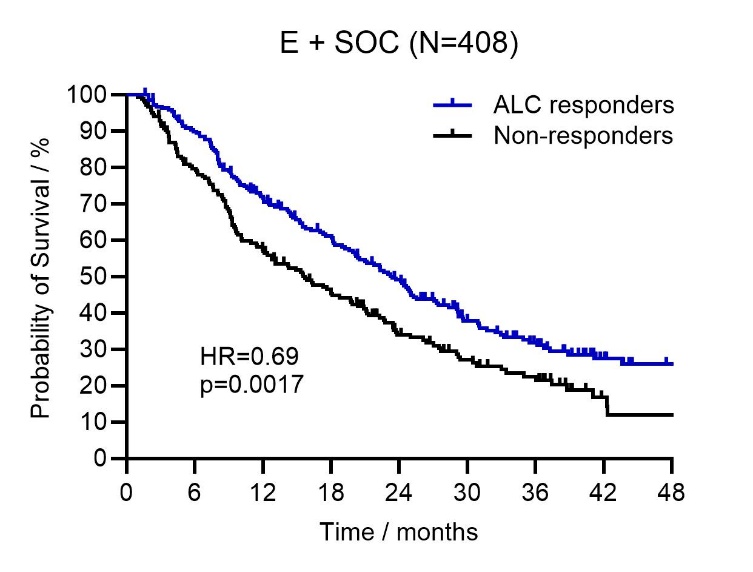

Effects were observed across the different tumor types and were independent of the combination partner i.e., chemotherapy or immunotherapy such as PD-1 antagonists.
“These findings link the immune-activating effect of efti measured in patients´ blood with meaningful and significant survival improvements observed in previous clinical trials. Importantly, this highlights a key connection between efti´s mechanism of action and clinical efficacy,” said Frederic Triebel, Chief Scientific Officer of Immutep.
In addition, treatment with efti plus SOC was associated with a rapid and significant increase in circulating TH1-related biomarkers, which correlated with clinical response. Gene expression profiling further demonstrated enhanced T-cell function scores in responding patients.
Collectively, these data suggest that efti induced broad immune activation, including circulating immune cells, cytokine responses and gene expression, and that this activation was associated with improved clinical benefit in late-stage cancer patients across multiple tumor types.
The data will be presented in a poster at the 2026 American Society of Clinical Oncology (ASCO) Annual Meeting.
ASCO 2026 Poster Presentation Details
Title: Eftilagimod alfa, an APC activator via MHC class II, induced lymphocyte activation linked to improved survival in metastatic cancer patients
Poster Session: Developmental Therapeutics—Immunotherapy
Date and Time: 30 May 2026, 1:30 PM-4:30 PM CDT
Poster Board: 359
Abstract #: 2569
The poster will be available on the Posters & Publications section of Immutep’s website following the presentation.
TACTI Program Context
Efti has been tested in multiple clinical trials, including the TACTI program (TACTI-mel, TACTI-002, TACTI-003 and TACTI-004).
In March 2026, following a planned interim futility analysis, Immutep discontinued the TACTI-004 Phase III trial in first-line non-small cell lung cancer based on a recommendation from the Independent Data Monitoring Committee, and Immutep continues to review available data to understand factors behind the futility outcome and to evaluate implications for the broader eftilagimod alfa development program.
The data presented in this explorative analysis does not include data from the TACTI-004 study, as immune data collection for that trial had not been completed at the time of the analysis. All data presented were generated from earlier clinical trials.
About Immutep
Immutep Limited (ASX: IMM; NASDAQ: IMMP) is a clinical-stage biotechnology company targeting cancer and autoimmune diseases. The Company is developing novel immunotherapies based on Lymphocyte Activation Gene-3 (LAG-3). For more information, please visit www.immutep.com.
Forward-Looking Statements
This press release contains forward-looking statements, including statements regarding anticipated clinical development, regulatory progress and potential benefits of eftilagimod alfa. These forward-looking statements are based on current expectations, estimates and projections, and involve known and unknown risks, uncertainties and other important factors that could cause actual results to differ materially from those expressed or implied in such statements.
Factors that could cause actual results to differ materially include risks associated with clinical trial outcomes, regulatory developments, and the Company’s ability to advance its product candidates.
Readers are cautioned not to place undue reliance on forward-looking statements, which speak only as of the date of this release. Immutep undertakes no obligation to update or revise such statements, except as required by applicable law.
Disclaimer
This announcement has been prepared for informational purposes only and does not constitute an offer to sell, or a solicitation of an offer to buy, securities in any jurisdiction.
Australian Investors/Media:
Eleanor Pearson, Sodali & Co.
+61 2 9066 4071; eleanor.pearson@sodali.com
U.S. Investors/Media:
Matthew Beck, astr partners
+1 (917) 415-1750; matthew.beck@astrpartners.com
1 Overall survival was compared using Kaplan-Meier estimates and a log-rank test.
2 Details of the analysis are described on the poster in the methods section.
