
STOCK TITAN

Illumina whole-genome sequencing technology to accelerate rare disease testing in Florida

(Neutral)
(Neutral)
Tags

Illumina (NASDAQ: ILMN) announced on February 27, 2026 that Illumina Laboratory Services will provide clinical whole-genome sequencing and interpretation services to the Diagnostic Lab at the Florida Institute for Pediatric Rare Diseases (IPRD) at Florida State University College of Medicine. The collaboration aims to accelerate rare-disease diagnostics and shorten the diagnostic odyssey for patients.

The partnership builds on existing ties with FSU, used Illumina implementation support for workflow enablement, and coincides with Rare Disease Day events and a livestreamed talk by Illumina's chief medical officer.

Loading...
Loading translation...

Positive

  • None.

Negative

  • None.

News Market Reaction – ILMN

+5.54%
26 alerts
+5.54% News Effect
+$1.08B Valuation Impact
$20.60B Market Cap
1.2x Rel. Volume

On the day this news was published, ILMN gained 5.54%, reflecting a notable positive market reaction. Our momentum scanner triggered 26 alerts that day, indicating elevated trading interest and price volatility. This price movement added approximately $1.08B to the company's valuation, bringing the market cap to $20.60B at that time.

Data tracked by StockTitan Argus on the day of publication.

Market Context

The stock moved +5.5% in the session following this news. A strong positive reaction aligns with Ill...
Analysis

The stock moved +5.5% in the session following this news. A strong positive reaction aligns with Illumina’s strategy of expanding clinical use cases for its sequencing platforms. The Florida State University rare-disease collaboration reinforces demand for whole-genome diagnostics and follows recent product and roadmap announcements in February 2026. Investors reviewing sustainability would weigh how quickly such partnerships translate into recurring test volumes, alongside prior earnings where FY 2025 revenue was $4.34B and guidance framed expectations for FY 2026.

Key Figures

Children with rare diseases: 15 million People with rare diseases: 30 million
2 metrics
Children with rare diseases 15 million Rare diseases affecting American children as cited in article
People with rare diseases 30 million Estimated people with rare disease across the U.S.

Historical Context

5 past events · Latest: Feb 25 (Positive)
Pattern 5 events
Date Event Sentiment 24h Move Catalyst
Feb 25 Oncology tech highlight Positive -0.8% Showcased customer oncology breakthroughs using advanced multiomics technologies.
Feb 24 Product launch Positive +2.0% Launched TruPath Genome whole‑genome solution with improved accuracy and workflow.
Feb 23 Platform roadmap Positive +2.4% Unveiled 18‑month NovaSeq X roadmap to enhance output, speed, and flexibility.
Feb 17 Investor conference Neutral -0.3% Announced webcast of fireside chat at a major health care conference.
Feb 5 Earnings results Neutral -10.4% Reported Q4 and FY 2025 results with flat annual revenue and 2026 guidance.

24h Move is the share-price change in the day after each event; other market factors may also have contributed.

Pattern Detected

Recent product and technology announcements often saw modest positive moves, with one divergence where oncology-tech news coincided with a small decline.

Recent Company History

Over February 2026, Illumina released a steady stream of product and platform updates. NovaSeq X roadmap enhancements on Feb 23 and the TruPath Genome launch on Feb 24 both saw positive next‑day moves. An oncology customer‑breakthrough update on Feb 25 drew a mild negative reaction. Earlier, Q4/FY 2025 earnings on Feb 5 led to a sharper -10.4% move. Today’s Florida rare‑disease collaboration fits the narrative of expanding clinical applications for its sequencing technology.

Key Terms

clinical whole-genome sequencing, genomic sequencing, clia-certified, clinical samples, +3 more
7 terms
clinical whole-genome sequencing medical
"Increased adoption of clinical whole-genome sequencing is advancing diagnostics"
Clinical whole-genome sequencing is a medical test that reads a person’s entire DNA — like scanning the complete instruction manual of a body — to find genetic causes of disease or to guide treatment choices. For investors, it matters because it underpins faster, more precise diagnostics and personalized therapies, affects demand for testing platforms and services, and is tied to regulatory approval, reimbursement and cost trends that drive commercial growth.
genomic sequencing medical
"advanced genomic sequencing and interpretation are crucial for uncovering novel mutations"
Genomic sequencing is the process of reading the exact order of the DNA building blocks that make up an organism’s complete genetic instruction manual, like decoding every letter in a very long book. For investors, it matters because that decoded information drives new diagnostics, targeted drugs, and personalized treatments, shaping which biotech products reach the market, how companies compete, and the size and timing of potential revenues or partnerships.
clia-certified regulatory
"Illumina Laboratory Services, Illumina's CLIA-certified laboratory, is providing clinical sequencing"
CLIA-certified means a laboratory has passed U.S. federal standards for performing tests on human samples, showing its results are accurate, reliable and timely. For investors this matters because certification is often required to sell clinical test services, bill insurers, win hospital or physician partnerships and avoid regulatory penalties — much like a restaurant passing a health inspection or a car getting a safety sticker before it can be sold.
clinical samples medical
"it's a new ball game when you're talking about clinical samples"
Clinical samples are biological specimens taken from patients or study volunteers—such as blood, tissue, saliva, or swabs—used to measure how a drug, medical device, or diagnostic performs in real people. For investors they matter because these samples generate the data that proves whether a product is effective, safe and scalable; think of them as the raw footage researchers analyze to determine a program’s chances of regulatory approval and commercial success.
clinical diagnostic testing medical
"to rapidly initiate their clinical diagnostic testing through clinical genome sequencing"
Clinical diagnostic testing is the use of laboratory tests and medical devices to detect, measure or monitor diseases, infections, or health markers in patients. Investors care because these tests drive revenue for health companies, influence healthcare spending and regulatory approval can rapidly expand market access—think of them as the sensors and checkups that tell doctors what’s happening inside the body and determine which products hospitals and clinics must buy.
clinical genome sequencing medical
"clinical diagnostic testing through clinical genome sequencing and interpretation services"
Clinical genome sequencing reads a patient’s full DNA sequence to identify genetic causes of disease, predict risk, or guide treatment decisions, producing a detailed map of a person’s genes used by doctors. It matters to investors because wider use can shift healthcare toward more precise, personalized care — changing demand for diagnostic tests, therapies and data services, altering revenues, regulatory exposure and long‑term growth prospects for companies across the medical and biotech sectors.
rare genetic diseases medical
"Diagnosing rare genetic diseases is challenging—advanced genomic sequencing"
Rare genetic diseases are medical conditions caused by uncommon changes in a person’s genes that disrupt how the body works, often appearing early in life and affecting a very small number of people. For investors they matter because developing a successful treatment can command premium pricing and regulatory support—like finding a niche product with little competition—yet research is costly and outcomes are binary, so trial results and approvals can sharply move a company’s value.

AI-generated analysis. How Rhea-AI works. Not financial advice.

See more from StockTitan in Google Search and AI answers. Adds StockTitan as a preferred source · opens Google
Add on Google

Increased adoption of clinical whole-genome sequencing is advancing diagnostics for rare diseases, which affect 15 million American children
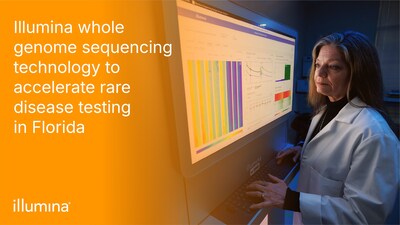
SAN DIEGO, Feb. 27, 2026 /PRNewswire/ -- Illumina, Inc. (NASDAQ: ILMN) today announced that Illumina Laboratory Services, Illumina's CLIA-certified laboratory, is providing clinical sequencing and interpretation services to the new Diagnostic Lab at Florida Institute for Pediatric Rare Diseases (IPRD) at Florida State University (FSU) College of Medicine, further driving innovation in diagnostics and treatments for rare diseases.

"An estimated 30 million people across the country are living with a rare disease today and clinical whole-genome testing provides a transformative opportunity to end the diagnostic odyssey for patients," said Eric Green, MD, PhD, chief medical officer of Illumina. "Our colleagues at IPRD will now be equipped to break diagnostic barriers, and we are proud to help them accelerate making life-saving discoveries."

Diagnosing rare genetic diseases is challenging—advanced genomic sequencing and interpretation are crucial for uncovering novel mutations that can be hidden in deep parts of the genome. Furthermore, results must be reliable and actionable for clinicians who are often presented with diseases they have never encountered previously. Illumina's goal is to equip more labs with the solutions and tools they need to diagnose rare diseases more consistently and help reduce the time it takes to transition from diagnosis to clinical management.

"I've been running Illumina sequencers for over 10 years, but it's a new ball game when you're talking about clinical samples," said Cynthia Vied, PhD, scientific director, IPRD Diagnostic Lab at FSU College of Medicine. "We have learned how to do things much differently in the clinical lab compared to my work in the research facility, and I think it has helped both sides."

"Now, all the work we do means we can impact a patient—a child—and a family going through a challenging health situation," continued Vied. "We can help them understand and hopefully help the physicians provide a treatment based on the diagnoses that we're going to provide from the lab. That, to me, is extraordinary."   

Building on a long-standing relationship between Illumina and FSU College of Medicine, the IPRD Diagnostic Lab utilized services from the Illumina Customer Success and Implementation team for workflow enablement. Illumina Laboratory Services enabled the IPRD Diagnostic Lab to rapidly initiate their clinical diagnostic testing through clinical genome sequencing and interpretation services.

With a mission to improve human health by unlocking the power of the genome, Illumina is proud to support customers like IPRD who are dedicated to finding answers for patients with rare genetic disease. In recognition of Rare Disease Day, Dr. Green is speaking at FSU today, February 27. The event will be livestreamed and available for playback here. Read more about how Illumina is supporting the rare disease community here.

About Illumina

Illumina is improving human health by unlocking the power of the genome. Our focus on innovation has established us as a global leader in DNA sequencing and array-based technologies, serving customers in the research, clinical, and applied markets. Our products are used for applications in the life sciences, oncology, reproductive health, agriculture, and other emerging segments. To learn more, visit illumina.com and connect with us on X, Facebook, LinkedIn, Instagram, TikTok, and YouTube.    

Contacts 

Investors: 
Illumina Investor Relations
858-291-6421
IR@illumina.com

Media: 
Christine Douglass
PR@illumina.com

Cision View original content to download multimedia:https://www.prnewswire.com/news-releases/illumina-whole-genome-sequencing-technology-to-accelerate-rare-disease-testing-in-florida-302699193.html

SOURCE Illumina, Inc.

FAQ

What is Illumina announcing about whole-genome sequencing for IPRD at FSU (ILMN) on February 27, 2026?

Illumina is providing clinical whole-genome sequencing and interpretation services to the IPRD Diagnostic Lab at FSU. According to the company, Illumina Laboratory Services and the Customer Success team enabled rapid initiation of clinical diagnostic testing and workflow enablement.

How will Illumina's (ILMN) services affect rare disease testing timelines at FSU's IPRD?

The services aim to reduce diagnostic time and help end the diagnostic odyssey for patients. According to the company, clinical genome sequencing and interpretation are intended to produce reliable, actionable results for clinicians.

Who at Illumina commented on the collaboration with FSU's IPRD (ILMN) and what did they say?

Eric Green, MD, PhD, Illumina chief medical officer, highlighted the potential to end the diagnostic odyssey for patients. According to the company, he noted clinical whole-genome testing as a transformative opportunity for rare-disease diagnosis.

Did Illumina (ILMN) provide implementation support to the IPRD Diagnostic Lab at FSU?

Yes — Illumina's Customer Success and Implementation team supported workflow enablement for the IPRD Diagnostic Lab. According to the company, this support allowed the lab to rapidly initiate clinical genome sequencing and interpretation services.

Is there an event tied to Illumina's (ILMN) IPRD announcement on February 27, 2026?

Yes — Illumina's chief medical officer spoke at FSU on Rare Disease Day, February 27, 2026, and the talk was livestreamed. According to the company, the event was available for live viewing and subsequent playback.
