STOCK TITAN

Hesai Powers Safety-Certified AI Autonomy for Smart Logistics with 3D Lidar at MODEX 2026

Rhea-AI Impact
(Moderate)
Rhea-AI Sentiment
(Positive)
Tags
AI

Hesai (NASDAQ: HSAI) showcased its JT128 mini 3D lidar at MODEX 2026 and announced a collaboration with Thoro.ai to power the latter’s safety-certified AI autonomy across industrial and commercial robots.

The JT128 will equip four new autonomous mobile robots launching next year, offering a 30 mm window height, 70% smaller volume, and a 360°×187° ultra-hemispherical field of view for all-around perception.

Loading...
Loading translation...

AI-generated analysis. Not financial advice.

Positive

  • Four AMRs to ship next year powered by JT128
  • JT128 achieves 70% smaller volume vs. similar products
  • 360°×187° ultra-hemispherical field of view enabling vertical awareness

Negative

  • None.

News Market Reaction – HSAI

+5.15%
1 alert
+5.15% News Effect

On the day this news was published, HSAI gained 5.15%, reflecting a notable positive market reaction.

Data tracked by StockTitan Argus on the day of publication.

Key Figures

MODEX year: 2026 New autonomous robots: 4 robots JT128 window height: 30 mm +3 more
6 metrics
MODEX year 2026 MODEX 2026 logistics trade show in Atlanta
New autonomous robots 4 robots Four new autonomous mobile robots slated for release next year
JT128 window height 30 mm Slim 30 mm window height for compact integration
Size reduction 70% smaller volume JT128 volume compared to similar products
Field of view 360° × 187° JT128 ultra-hemispherical field of view with no blind spots
Booth location Hall A #5306 Hesai’s booth at MODEX 2026

Market Reality Check

Price: $20.61 Vol: Volume 948,485 vs 20-day ...
low vol
$20.61 Last Close
Volume Volume 948,485 vs 20-day average 2,078,547 (relative volume 0.46x) suggests muted pre-news activity. low
Technical Shares at 22.34 trade below the 200-day MA of 23.71 and are 27.59% under the 52-week high 30.85, though still 114.6% above the 52-week low 10.41.

Peers on Argus

HSAI was down 1.41% while key auto-parts peers like AAP, DAN, GTX, ATMU and VC a...

HSAI was down 1.41% while key auto-parts peers like AAP, DAN, GTX, ATMU and VC all showed gains between 0.17% and 1.92%, pointing to stock-specific factors rather than a sector-wide move.

Previous AI Reports

2 past events · Latest: Mar 16 (Positive)
Same Type Pattern 2 events
Date Event Sentiment Move Catalyst
Mar 16 AI safety collaboration Positive -0.5% Joined NVIDIA Halos lab for safety and AI compliance validation.
Apr 24 AI robotaxi selection Positive +4.5% AT128 chosen as primary lidar for Pony.ai robotaxis.
Pattern Detected

Recent AI-tag headlines have been strategically positive, with one modestly negative and one positive price reaction, suggesting mixed but generally supportive trading responses to AI partnerships.

Recent Company History

Over the past year, Hesai’s AI-related news has focused on deepening its role in autonomous systems. On Mar 16, 2026, it joined the NVIDIA Halos AI Systems Inspection Lab to validate lidar platforms for safety, cybersecurity, and AI compliance. On Apr 24, 2025, its AT128 was selected as primary lidar for Pony.ai’s seventh‑generation Robotaxi fleet, each vehicle using four sensors. Today’s logistics‑focused AI autonomy collaboration extends this trajectory from robotaxis and AV safety into warehouse and industrial robotics.

Historical Comparison

+2.0% avg move · Past AI-tag releases averaged a 1.98% move, tied to safety validation and robotaxi design wins. This...
AI
+2.0%
Average Historical Move AI

Past AI-tag releases averaged a 1.98% move, tied to safety validation and robotaxi design wins. This MODEX 2026 logistics autonomy deal fits the pattern of strategic AI collaborations.

AI-related news has progressed from robotaxi and AV safety platforms toward broader industrial and warehouse robotics autonomy use cases.

Market Pulse Summary

The stock moved +5.2% in the session following this news. A strong positive reaction aligns with Hes...
Analysis

The stock moved +5.2% in the session following this news. A strong positive reaction aligns with Hesai’s pattern of using AI collaborations to broaden its lidar footprint. Prior AI-tag news around NVIDIA validation and robotaxis saw an average move of 1.98%. This logistics-focused deal extends that strategy into warehouses and industrial robots. Investors may weigh execution on new robot launches and broader robotics adoption as key factors for sustaining enthusiasm.

Key Terms

lidar, 3d lidar, autonomous mobile robots, field of view
4 terms
lidar technical
"Hesai Technology ..., a global leader in lidar solutions, attended MODEX 2026..."
Lidar, which stands for Light Detection and Ranging, is a technology that uses laser beams to create detailed, three-dimensional maps of the environment. It works like a sophisticated eye that measures distances by bouncing light off objects, helping machines see and understand their surroundings. For investors, lidar is important because it enables advancements in autonomous vehicles, robotics, and mapping, which can drive innovation and growth in related industries.
3d lidar technical
"... showcasing its latest 3D lidar solutions for smart logistics applications."
3D LiDAR is a sensor system that shoots rapid laser pulses and measures how long they take to bounce back, building a three-dimensional, point-by-point map of surrounding objects and distances. Investors care because LiDAR is a foundational technology for autonomous vehicles, robotics, mapping and safety systems; progress in range, resolution, cost or adoption can materially affect companies’ revenue prospects, margins and competitive position—it's like giving machines precise eyes and a measuring tape.
autonomous mobile robots technical
"Four new autonomous mobile robots slated for release next year..."
Autonomous mobile robots are self-guided machines that move around workplaces—like self-driving carts or robotic helpers—to carry goods, inspect equipment, or perform routine tasks without a person steering them. They matter to investors because they can lower labor costs, speed up operations, and scale capacity much like adding more automated assembly lines, while also carrying adoption, integration and regulatory risks that can affect a business’s cost structure and growth prospects.
field of view technical
"the JT128 features the world's widest 360° × 187° ultra-hemispherical field of view..."
Field of view is the angular or spatial area that an optical device, sensor or camera can see at one time — like the scene visible through a window or on a camera screen. For investors, field of view affects product usefulness, unit economics and market appeal because a wider or more precise view can reduce the number of devices needed, improve performance in applications (security, medical imaging, drones) and influence regulatory testing and sales prospects.

AI-generated analysis. Not financial advice.

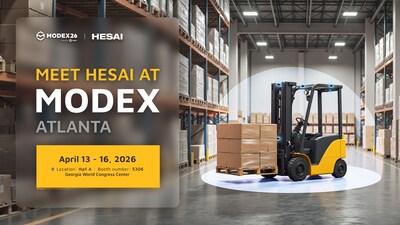
PALO ALTO, Calif., April 14, 2026 /PRNewswire/ -- Hesai Technology (NASDAQ: HSAI; HKEX: 2525), a global leader in lidar solutions, attended MODEX 2026 in Atlanta, showcasing its latest 3D lidar solutions for smart logistics applications. At the event, Hesai highlighted its collaboration with Thoro.ai, a Pittsburgh-based, industry-leading robotics company. Hesai will supply its high-performance mini 3D lidar, the JT128, to power Thoro.ai's perception platform across a wide range of robotic applications, including the industry's first safety-certified AI autonomy platform for industrial and commercial robots.

Hesai Powers Safety-Certified AI Autonomy for Smart Logistics with 3D Lidar at MODEX 2026

Thoro.ai is a software-first robotics company dedicated to enabling OEMs to launch safety-certified autonomous solutions with minimal in-house development. Through CoreFlex — a unified sensor and software suite — OEMs can accelerate time to market, reduce costs, and scale a single autonomy solution across multiple robot types. High-performance sensors like Hesai's JT128 are critical to making this versatile architecture a reality, providing reliable data that can be used consistently across different machines and applications.

Hesai's collaboration with Thoro.ai has already begun with significant developments underway. Four new autonomous mobile robots slated for release next year will all be powered by the JT128 lidar. Designed for various workflows across cleaning and material handling, this integration highlights the scalability of CoreFlex and the JT128's ability to accelerate a wide range of autonomous applications.

With its slim 30 mm window height and a 70% smaller volume compared to similar products, the JT128 can be easily integrated into machines of all sizes, from small cleaning robots to large industrial robots. Its compact form factor helps Thoro.ai streamline hardware integration and simplify development, enabling OEM partners to adopt autonomy faster.

In addition to its compact size, the JT128 features the world's widest 360° × 187° ultra-hemispherical field of view, delivering all-around perception coverage with no blind spots. In warehouse environments, some of Thoro.ai's robots require vertical awareness to detect objects beneath forks and align with rack beams above. The vertical field of view of the JT128 enables true autonomous pallet handling while meeting strict safety standards.

Because lidar actively emits laser light, it is not affected by ambient lighting conditions. This makes the JT128 highly reliable across all of Thoro.ai's robotic applications, including challenging environments with reflective surfaces and glass.

"At Thoro.ai, we think about each of these OEM partnerships not just as standalone projects, but as part of our CoreFlex autonomy architecture: a modular, safety-certified platform designed to scale across many machine types," says Patrick Mondi, CEO of Thoro.ai. "The JT series plays a key role in making that possible by giving us reliable, high-fidelity perception that works consistently across very different form factors. This simplifies the integration process for our partners, lowers their development costs, and gets their autonomous solutions to market faster. Hesai's responsiveness, bug testing, and rapid iteration cycles also align directly with our mission to deliver safe, reliable autonomy at scale."

The collaboration between Hesai and Thoro.ai marks a significant step forward in the robotics industry. By integrating Thoro.ai's advanced AI-driven autonomy software with Hesai's high-performance JT128 lidar, the two companies are enabling OEMs to launch autonomous mobile robots that are safer, more intelligent, and faster to deploy. Visitors are invited to stop by Hesai's booth (Hall A #5306) at MODEX 2026 to see firsthand how the company's latest innovations are shaping the future of smart logistics.

Cision View original content to download multimedia:https://www.prnewswire.com/news-releases/hesai-powers-safety-certified-ai-autonomy-for-smart-logistics-with-3d-lidar-at-modex-2026-302741212.html

SOURCE Hesai Technology

FAQ

What did Hesai announce about its JT128 lidar at MODEX 2026 (HSAI)?

Hesai announced JT128 integration with Thoro.ai for safety-certified autonomy across robots. According to Hesai, the JT128 will power four new autonomous mobile robots slated for release next year and is designed for easy OEM integration.

How does the JT128 form factor affect OEM integration for HSAI customers?

The JT128’s compact size simplifies integration into varied machines. According to Hesai, the sensor has a 30 mm window height and 70% smaller volume than similar products, easing hardware design for cleaning and material-handling robots.

What perception coverage does Hesai claim the JT128 provides for HSAI applications?

The JT128 offers full all-around perception with wide vertical coverage. According to Hesai, it delivers a 360°×187° ultra-hemispherical field of view, enabling vertical awareness for tasks like pallet handling and rack alignment.

Will Hesai’s JT128 improve reliability in challenging warehouse lighting for HSAI deployments?

Yes—lidar is insensitive to ambient light, improving reliability in warehouses. According to Hesai, JT128 actively emits laser light, maintaining performance on reflective surfaces and glass where vision sensors can struggle.

What role does Thoro.ai’s CoreFlex play in the Hesai (HSAI) partnership?

CoreFlex provides a unified sensor and software suite for OEMs to deploy autonomy faster. According to Thoro.ai, CoreFlex plus the JT128 allows scaling a single safety-certified autonomy solution across multiple robot types.

How does the Hesai and Thoro.ai collaboration affect time to market for OEMs (HSAI)?

The partnership aims to shorten OEM development and deployment cycles. According to Thoro.ai, JT series sensors and CoreFlex reduce integration complexity, lower development costs, and accelerate autonomous product launches.