
Army Selects AV’s VAPOR® CLE for Medium Range Reconnaissance Program
Key Terms
unmanned aircraft system (uas) technical
vertical takeoff and landing (vtol) technical
small uncrewed aircraft system (suas) technical
brigade combat teams (bcts) technical
reconnaissance, surveillance, and target acquisition technical
modular open architecture technical


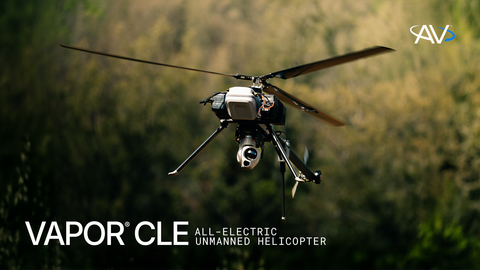
AV’s VAPOR® Compact Long Endurance (CLE) unmanned aircraft system—an all-electric VTOL platform – was selected for the Army’s Medium Range Reconnaissance program. (Photo AV)
The award supports the Army’s Medium Range Reconnaissance (MRR) initiative, one of the Army’s ongoing unmanned systems procurements.
“Being selected for the Company-Level Directed Requirement validates VAPOR CLE’s performance, adaptability, and mission value,” said Jason Hendrix, Vice President and General Manager of SUAS at AV. “This award reflects AV’s commitment to delivering operationally relevant, rapidly deployable solutions that meet the Army’s urgent needs and evolving mission requirements.”
The Army’s CoLvl DR effort delivers commercially available SUAS capabilities to Brigade Combat Teams (BCTs) to meet immediate operational needs, emphasizing UAS as a complete system. This approach enables modular, reconfigurable, and attritable payloads for reconnaissance, surveillance, and target acquisition, while enhancing adaptability, operational effectiveness, and soldier-driven experimentation to shape future requirements.
Engineered for demanding missions, the VAPOR CLE all-electric helicopter UAS sets a new standard for endurance, payload capacity, and field adaptability. Designed for operations across austere environments — from Arctic terrain to contested maritime conditions — the platform combines rugged reliability with a compact, deploy-anywhere design. Its modular open architecture and multi-sensor payload bay make it one of the most versatile small VTOL systems available.
Its folding airframe and compact pack-out system enable case-to-flight in as little as two minutes, delivering exceptional portability and speed to launch. Ruggedized for extreme weather and harsh sea states, VAPOR CLE can carry up to 24 pounds of payload or lethal munitions and deliver up to two hours of endurance, outperforming other all-electric quadcopters and competing helicopter UAS platforms in its class.
About AV
AeroVironment (“AV”) (NASDAQ: AVAV) is a defense technology leader delivering integrated capabilities across air, land, sea, space, and cyber. The Company develops and deploys autonomous systems, loitering munitions, counter-UAS technologies, space-based platforms, directed energy systems, and cyber and electronic warfare capabilities—built to meet the mission needs of today’s warfighter and tomorrow’s conflicts. At the core of these technologies lies AV_Halo™, a modular, mission-ready suite of AI-powered software tools that empowers warfighters and enables full-battlefield dominance: detect, decide, deliver. With a national manufacturing footprint and a deep innovation pipeline, AV delivers proven systems and future-defining capabilities at speed, scale, and operational relevance. For more information, visit www.avinc.com.
Safe Harbor Statement
Certain statements in this press release may constitute "forward-looking statements" as defined in the Private Securities Litigation Reform Act of 1995. These statements are based on current expectations, forecasts, and assumptions that involve risks and uncertainties, which could cause actual results to differ materially. Factors that may cause such differences include, but are not limited to, our ability to perform under existing contracts and obtain new ones; regulatory changes; competitor activities; market growth; product development challenges; and general economic conditions. For a more detailed discussion of these risks, please refer to AeroVironment’s filings with the Securities and Exchange Commission. We undertake no obligation to update forward-looking statements as a result of new information or future events.
View source version on businesswire.com: https://www.businesswire.com/news/home/20260416053128/en/
Media Contact:
BJ Koubaroulis
pr@avinc.com
747.324.5358
Investor Contact:
Denise Pacioni
ir@avinc.com
805.795.4108
Source: AeroVironment, Inc.