
FCC Grants AST SpaceMobile Commercial Authority to Deliver Direct-to-Device Cellular Broadband from Space Advancing Nationwide, Resilient Cellular Broadband Connectivity in the United States
Key Terms
non-geostationary orbit (ngso) technical
low earth orbit (leo) technical
feeder links technical
telemetry, tracking, and command (tt&c) technical
v-band spectrum technical
s-band technical
uhf spectrum technical




Approval enables supplemental coverage from space using 700/800 MHz premium low-band spectrum in coordination with strategic partners Verizon, AT&T, and FirstNet
Supports global deployment with international operating rights for feeder links and sub-1 GHz direct-to-device spectrum, enabling country-by-country authorizations
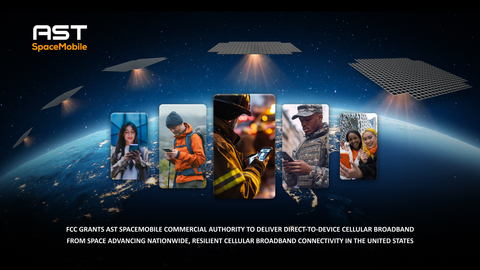
FCC Grants AST SpaceMobile Commercial Authority to Deliver Direct-to-Device Cellular Broadband from Space Advancing Nationwide, Resilient Cellular Broadband Connectivity in
The authorization enables AST SpaceMobile to deploy and operate an NGSO constellation of up to 248 satellites to deliver Supplemental Coverage from Space (SCS) directly to unmodified mobile devices across
By integrating directly with partner mobile network operator infrastructure, the AST SpaceMobile network enhances network resilience, supports critical communications for first responders, government agencies, enterprises and consumers, and enables users to access space-based cellular broadband using standard, unmodified smartphones.
The grant reflects the Commission’s recognition of AST SpaceMobile’s ability to operate alongside existing terrestrial networks while managing interference and complying with applicable technical requirements, further validating the company’s unique technology and system design. It also supports the broader regulatory framework for AST SpaceMobile’s global deployment, enabling country-by-country authorizations across multiple frequency bands.
AST SpaceMobile system is designed to operate across a broad range of frequency bands supporting feeder links, telemetry, tracking, and command (TT&C), and service links globally, with updated technical parameters designed to enhance performance and efficiency, including
-
Low-band cellular spectrum for direct-to-device service links in
the United States and globally - V-band spectrum for gateway and feeder link operations (37.5–42.0 GHz, 45.5-47 GHz, 47.2–50.2 GHz, 50.4–51.4 GHz)
- S-band and UHF spectrum for TT&C operations
Today marks an important step as we continue scaling our network and moving closer to commercial service,” said Abel Avellan, Founder, Chairman, and CEO of AST SpaceMobile. “We are accelerating deployment of our constellation, advancing integration with leading mobile network operators, and preparing to deliver seamless, space-based cellular broadband directly to everyday smartphones, bringing us closer to connecting people everywhere.”
AST SpaceMobile is approximately
About AST SpaceMobile
AST SpaceMobile is building the first and only global cellular broadband network in space to operate directly with standard, unmodified mobile devices based on our extensive IP and patent portfolio, and designed for both commercial and government applications. Our engineers and space scientists are on a mission to enable 4G and 5G space-based cellular broadband to every device, everywhere, for today’s nearly 6 billion mobile subscribers globally. For more information, follow AST SpaceMobile on YouTube, X (Formerly Twitter), LinkedIn and Facebook. Watch this video for an overview of the SpaceMobile mission.
Forward-Looking Statements
This communication contains “forward-looking statements” that are not historical facts, and involve risks and uncertainties that could cause actual results of AST SpaceMobile to differ materially from those expected and projected. These forward-looking statements can be identified by the use of forward-looking terminology, including the words “believes,” “estimates,” “anticipates,” “expects,” “intends,” “plans,” “may,” “will,” “would,” “potential,” “projects,” “predicts,” “continue,” or “should,” or, in each case, their negative or other variations or comparable terminology. These forward-looking statements involve significant risks and uncertainties that could cause the actual results to differ materially from the expected results. Most of these factors are outside AST SpaceMobile’s control and are difficult to predict.
Factors that could cause such differences include, but are not limited to: (i) expectations regarding AST SpaceMobile’s strategies and future financial performance, including AST’s future business plans or objectives, expected functionality of the SpaceMobile Service, anticipated timing of the launch of the Block 2 BlueBird satellites, anticipated demand and acceptance of mobile satellite services, prospective performance and commercial opportunities and competitors, the timing of obtaining regulatory approvals, ability to finance its research and development activities, commercial partnership acquisition and retention, products and services, pricing, marketing plans, operating expenses, market trends, revenues, liquidity, cash flows and uses of cash, capital expenditures, and AST SpaceMobile’s ability to invest in growth initiatives; (ii) the negotiation of definitive agreements with mobile network operators relating to the SpaceMobile Service that would supersede preliminary agreements and memoranda of understanding and the ability to enter into commercial agreements with other parties or government entities; (iii) the ability of AST SpaceMobile to grow and manage growth profitably and retain its key employees and AST SpaceMobile’s responses to actions of its competitors and its ability to effectively compete; (iv) changes in applicable laws or regulations; (v) the possibility that AST SpaceMobile may be adversely affected by other economic, business, and/or competitive factors; (vi) the outcome of any legal proceedings that may be instituted against AST SpaceMobile; and (vii) other risks and uncertainties indicated in the Company’s filings with the Securities and Exchange Commission (SEC), including those in the Risk Factors section of AST SpaceMobile’s Form 10-K filed with the SEC on March 2, 2026.
AST SpaceMobile cautions that the foregoing list of factors is not exclusive. AST SpaceMobile cautions readers not to place undue reliance upon any forward-looking statements, which speak only as of the date made. For information identifying important factors that could cause actual results to differ materially from those anticipated in the forward-looking statements, please refer to the Risk Factors in AST SpaceMobile’s Form 10-K filed with the SEC on March 2, 2026. AST SpaceMobile’s securities filings can be accessed on the EDGAR section of the SEC’s website at www.sec.gov. Except as expressly required by applicable securities law, AST SpaceMobile disclaims any intention or obligation to update or revise any forward-looking statements whether as a result of new information, future events or otherwise.
View source version on businesswire.com: https://www.businesswire.com/news/home/20260422147378/en/
Investor Contact:
Scott Wisniewski
investors@ast-science.com
Media Contact:
Allison
Eva Murphy Ryan
917-547-7289
AstSpaceMobile@allisonpr.com
Source: AST SpaceMobile, Inc.