






Kansas City University Sets New Standard in Point-of-Care Ultrasound Education with AI-Guided Training Curriculum
Rhea-AI Summary
Kansas City University (KCU) is pioneering point-of-care ultrasound (POCUS) education by introducing a first-of-its-kind, hands-on POCUS elective in its 2024 curriculum. KCU is the first U.S. medical school to use Butterfly Network's AI-guided ScanLab™ application as the foundation of its POCUS curriculum. The program focuses on student scanning proficiency, ensuring graduates are prepared for residency and clinical settings.
The AI-powered ScanLab™ app provides real-time feedback, anatomical labeling, and grading, enabling students to learn independently. Nearly 300 students have enrolled in KCU's POCUS elective series, using personal Butterfly handheld ultrasound devices. This innovative approach addresses the gap in POCUS training in medical schools, setting a new standard for medical education in the 21st century.
Positive
- KCU becomes the first U.S. medical school to use Butterfly Network's AI-guided ScanLab™ in its POCUS curriculum
- Nearly 300 students enrolled in KCU's POCUS elective series
- Students use personal Butterfly handheld ultrasound devices for training
- The program addresses a gap in POCUS training in medical schools
Negative
- None.
News Market Reaction – BFLY
On the day this news was published, BFLY declined 2.67%, reflecting a moderate negative market reaction.
Data tracked by StockTitan Argus on the day of publication.


KCU incorporates Butterfly Network's AI-guided ScanLab™ education application into its curriculum to empower dedicated, hands-on ultrasound training.
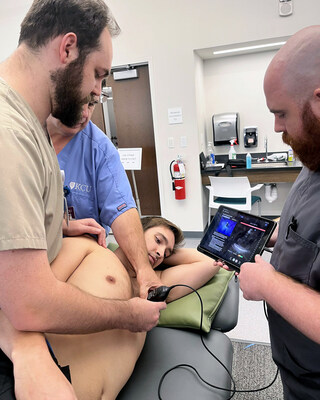
KCU's innovative POCUS program uses the AI-powered ScanLab™ app to provide students with dedicated feedback and guidance that is key to strengthening skills in essential scans, including cardiac, lung and eFAST (Extended Focused Assessment with Sonography in Trauma). The app offers real-time anatomical labeling, step-by-step instructions and feedback on probe placement, all while comparing students' scans to reference images. The AI tool even grades the scans, enabling students to learn independently and refine their skills efficiently.
While POCUS is becoming increasingly vital in modern health care, most medical schools still fail to provide consistent training in this area. Physicians often acquire these essential skills during postgraduate training. KCU is addressing this gap by integrating comprehensive POCUS training into its curriculum, ensuring students are equipped for residency right from the start.
"When you get to residency, there's a lot to learn," said Robert Arnce, MD, director of clinical integration at KCU. "If our students enter with POCUS proficiency, that's one less skill they need to master, and it distinguishes them from other residents."
John Martin, MD, chief medical officer at Butterfly Network, added, "Empowering students with POCUS skills not only gives them a leg up entering residency but will ultimately lead to higher quality patient care. The AI-powered insights from Butterfly ScanLab are designed to give every student the personal mentorship they need to scan confidently. By integrating this technology into their program, KCU is setting a new standard for medical training in the 21st century."
This academic year alone, nearly 300 students have enrolled in KCU's POCUS elective series, using their own personal Butterfly handheld ultrasound devices. As they progress, students simultaneously complete related courses in Butterfly Academy, building confidence and expanding their ultrasound skills at their own pace. With each completed course, students earn certifications, further solidifying their expertise.
"I performed an eFAST exam, a cardiac exam, and a lung exam. It was incredibly valuable to visualize different structures and gain a deeper understanding of anatomy," said first-year medical student Bryant Pace.
Beyond its educational impact, the mobility and versatility of the Butterfly probe make it indispensable in resource-limited settings, such as rural hospitals or disaster environments. Unlike traditional ultrasound machines, this tool's portability ensures high-quality care even in challenging circumstances.
"This is a physician skill—one that directly translates into their ability to care for patients," Arnce continued. "While many aspects of medical school are theoretical, POCUS training gives our students the hands-on experience they need to make a real impact in clinical settings. Research shows that point-of-care ultrasound significantly increases patient satisfaction because doctors spend more time at the bedside. It transforms patient care by integrating ultrasound into daily assessments, diagnoses, and treatments."
Through its pioneering use of AI-powered tools and its strong focus on practical ultrasound training,
About
About Butterfly Network
Founded by Dr. Jonathan Rothberg in 2011, Butterfly Network is a digital health company with a mission to democratize medical imaging by making high-quality ultrasound affordable, easy-to-use, globally accessible, and intelligently connected, including for the 4.7 billion people around the world lacking access to ultrasound. Butterfly created the world's first handheld single-probe, whole-body ultrasound system using semiconductor technology, Butterfly iQ. The company has continued to innovate, leveraging the benefits of Moore's Law, to launch its second-generation Butterfly iQ+ in 2020, and third generation iQ3 in 2024 – each with increased processing power and performance enhancements. The disruptive technology has been recognized by TIME's Best Inventions, Fast Company's World Changing Ideas, CNBC Disruptor 50, and MedTech Breakthrough Awards, among other accolades. With its proprietary Ultrasound-on-Chip™ technology, intelligent software, and educational offerings, Butterfly is paving the way to mass adoption of ultrasound for earlier detection and remote management of health conditions around the world. Butterfly devices are commercially available to trained health care practitioners in areas including, but not limited to, parts of
Contact:
Haley Reardon
Director of Communications
417.208.0664 (office)
417.592.2223 (cell)
hreardon@kansascity.edu
Liz Learned Snyder
Head of Comms & PR
978.505.2567
llearned@butterflynetinc.com
 View original content to download multimedia:https://www.prnewswire.com/news-releases/kansas-city-university-sets-new-standard-in-point-of-care-ultrasound-education-with-ai-guided-training-curriculum-302268356.html
SOURCE
FAQ
What is Kansas City University's new approach to POCUS training?
How does the AI-powered ScanLab™ app benefit medical students?
How many students have enrolled in KCU's POCUS elective series?
What types of scans are included in KCU's POCUS training program?