
Neoclouds Not Ready for AI Networking, Omdia Warns
Key Terms
ipv4 technical
ip transit technical
internet exchanges (ixps) technical
tier 1 ip backbone technical
port capacity technical


Audit probes scale, resilience, and sovereignty; enterprises urged to check five risk areas
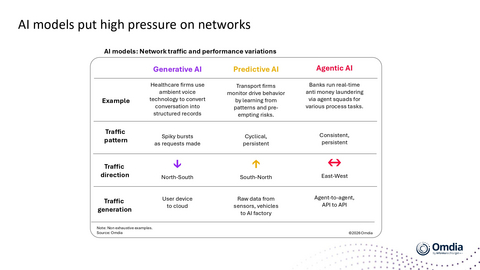
AI models Network traffic and performance variations
Omdia’s study, covering 50 neoclouds, finds that providers have scaled compute for AI workloads, but networking infrastructure is becoming a critical constraint. AI performance increasingly depends on the ability to process and move data securely across distributed environments and geographies.
“Network infrastructure will make or break neoclouds,” said Camille Mendler, Omdia Research Director, Telco B2B. “Low-latency, resilient and secure connectivity- from backbone to edge - is table stakes for success, not least because sovereignty spans where AI workloads move.”
Omdia identifies five key risk areas that enterprises adopting AI should investigate:
-
In-house skills:
43% of neoclouds are seeking network engineers and security specialists to fill urgent competency gaps. - Accountability: Certifications and service commitments for network uptime, security and data sovereignty need scrutiny; over a third of neoclouds minimize contractual liability.
- Cloud on-ramps: High-speed interconnection to clouds via public and private peering helps secure consistent performance; more than half of neoclouds do not use Internet peering exchanges.
-
IP assets: IP address ownership supports rapid growth, traffic localization and routing control;
46% of neoclouds only control small IPv4 address blocks. - IP transit resilience: One in five neoclouds relies on one IP transit provider, potentially creating a single point of failure.
Neocloud networking capabilities vary from rudimentary to advanced, depending in part on their origins, which include bitcoin mining, content distribution, and web hosting.
Omdia found that neocloud networking strategy is in flux globally. Many are rushing to partner, buy or build infrastructure as their dependency on networking grows:
-
A group of 15 providers led by Tier 1 IP backbone owners Arelion, Cogent, and Lumen control
47% of all identified neocloud IP transit relationships. -
Neoclouds use 64Tbps of aggregated port capacity at 191 Internet Exchanges (IXPs) worldwide, with Frankfurt’s De-CIX accounting for
10% of all port capacity. - Equinix and Digital Realty interconnect the most neoclouds within their global facilities.
Omdia’s Telecoms group provides insights on neoclouds and AI networking across multiple expert teams:
- Telco B2B Strategies: Neocloud networking and partnerships
- Telco B2B Solutions: AI network traffic and enterprise adoption
- Service Provider Strategies: Sovereignty
ABOUT OMDIA
Omdia, part of TechTarget, Inc. d/b/a Informa TechTarget (Nasdaq: TTGT), is a technology research and advisory group. Our deep knowledge of tech markets grounded in real conversations with industry leaders and hundreds of thousands of data points, make our market intelligence our clients’ strategic advantage. From R&D to ROI, we identify the greatest opportunities and move the industry forward.
View source version on businesswire.com: https://www.businesswire.com/news/home/20260415649117/en/
Fasiha Khan: fasiha.khan@omdia.com
Eric Thoo: eric.thoo@omdia.com
Source: Omdia