
Supermicro Introduces DCBBS Blueprints for NVIDIA Vera Rubin NVL72 and NVIDIA HGX™ Rubin NVL8, Built to Scale from 5MW to 1GW as an End-to-End Total Solution
Rhea-AI Summary
Supermicro (NASDAQ: SMCI) introduced DCBBS Blueprints for the NVIDIA Vera Rubin NVL72 and NVIDIA HGX Rubin NVL8 platforms. The end-to-end designs scale AI factories from 5MW to 1GW, combining compute, storage, networking, DLC-2 liquid cooling, power distribution, management software, and services.
Each scalable unit supports 1,152 NVIDIA Rubin GPUs with 331TB of HBM4. Deployments are planned for the second half of 2026, aligned with NVIDIA Vera Rubin general availability.
AI-generated analysis. Not financial advice.
Positive
- Gigawatt-scale designs from 5MW to 1GW AI factory power envelopes
- 1,152 NVIDIA Rubin GPUs and 331TB HBM4 per scalable unit
- DLC-2 direct liquid cooling stack with up to 5MW cooling towers
- Single-vendor blueprint covering compute, storage, networking, power, and cooling
- Multi-tenant capable SuperCloud software for unified GPU cloud management
- Deployments scheduled for second half of 2026, aligned with Vera Rubin GA
Negative
- None.
News Market Reaction – SMCI
On the day this news was published, SMCI gained 1.71%, reflecting a mild positive market reaction. Argus tracked a peak move of +4.9% during that session. Our momentum scanner triggered 31 alerts that day, indicating elevated trading interest and price volatility. This price movement added approximately $519M to the company's valuation, bringing the market cap to $30.85B at that time.
Data tracked by StockTitan Argus on the day of publication.
Key Figures
Market Reality Check
Peers on Argus
SMCI gained 11.6% while peers were mixed: HPQ +1.27%, PSTG +3.61%, LOGI +3.72%, but WDC -2.04% and STX -1.46%, indicating largely stock-specific strength.
Historical Context
| Date | Event | Sentiment | Move | Catalyst |
|---|---|---|---|---|
| May 28 | Export-control cooperation | Positive | +8.1% | Collaboration with Taiwanese authorities to block illicit server diversion. |
| May 27 | AI cloud partnership | Positive | +2.9% | Verda deploying Supermicro liquid‑cooled NVIDIA Blackwell systems for AI workloads. |
| May 15 | Investor conferences | Neutral | -6.0% | Announcement of participation in multiple upcoming technology investor events. |
| May 14 | CRO appointment | Positive | -6.0% | Appointment of a new Chief Revenue Officer and leadership transition. |
| May 11 | Executive & earnings | Positive | -2.2% | New Chief Business Officer and strong Q3 net sales with higher gross margin. |
Recent positive AI and partnership news often coincided with gains, while leadership changes and even strong financial updates saw negative reactions, showing a mixed but somewhat contrarian response pattern.
Over the past weeks, SMCI reported several notable developments. On May 11, it filed its 10‑Q alongside strong growth, with Q3 net sales reaching $10.2B and FY2026 net sales expected at $38.9–$40.4B. Mid‑May leadership appointments for the Chief Business Officer and Chief Revenue Officer coincided with share price declines. More recently, AI infrastructure and compliance news, including a collaboration with Taiwanese authorities and an AI cloud partnership with Verda, aligned with positive price reactions, framing today’s NVIDIA Rubin blueprint launch within an ongoing AI expansion story.
Market Pulse Summary
This announcement details SMCI’s DCBBS Blueprints for NVIDIA Vera Rubin–based AI factories, scaling from 5MW to 1GW and centered on 1,152‑GPU Rubin units with 331TB of HBM4 memory. It emphasizes end‑to‑end delivery, including direct liquid cooling, power distribution, and software management. In context of recent AI cloud wins and strong reported net sales, investors may watch how quickly these gigawatt‑scale designs convert into signed projects and measurable revenue contributions.
Key Terms
direct liquid cooling technical
infiniBand technical
nvlink technical
battery backup units technical
co-packaged optics technical
AI-generated analysis. Not financial advice.


- End-to-End Blueprint Scalable from a 5MW to 1GW Power Envelope with full facility-side infrastructure for either single-tenant or multi-tenant deployments
- DLC-2 Direct Liquid Cooling: engineered for near total heat capture, power efficiency, and lower noise with full stack integration of cold plates, CDUs, manifolds, rear door heat exchangers, cooling towers, and SMC PG25-A ultra-high electrical impedance coolant
- Management Software Suite: End-to-end SuperCloud software delivers unified infrastructure control, deployment automation, developer tools, and multi-tenant GPU cloud management
- In-Rack, In-Row, and Site Infrastructure Solutions covering every deployment layer from rack integration to in-row CDUs and SuperCluster configurations, to site-level infrastructure
- Dedicated Team of Supermicro Experts manage the complete deployment lifecycle: site survey, project design, integration, deployment, and ongoing support
- Supporting NVIDIA's latest reference architecture integrating NVIDIA Context Memory Storage Platform, NVIDIA Spectrum™-X Ethernet, and NVIDIA Quantum-X800 InfiniBand Platform
"The NVIDIA Vera Rubin NVL72 platform sets a new standard for AI factory performance, and our DCBBS Blueprints give customers a proven, end-to-end path to build at any scale — from 5MW to 1GW," said Charles Liang, president and CEO of Supermicro. "We have delivered some of the earliest and largest liquid-cooled AI factories, and that experience is built into every Blueprint — so our customers can move from design to fully operational faster than ever before."
Supermicro's DCBBS Blueprints address the challenges of the practical implementation behind the most advanced AI infrastructure in the world. The NVIDIA Vera Rubin platform vastly improves AI Factory performance density, doubling speeds across multiple computing domains. NVIDIA's latest reference architecture precisely defines what an ideal 1,152-GPU scalable unit should contain —a Supermicro's DCBBS Blueprint defines the steps to achieve deployment success, with a proven track record for deploying the world's largest liquid-cooled AI factories featuring over 100,000 GPUs.
For more information on DCBBS, visit https://www.supermicro.com/en/solutions/dcbbs
Supermicro's DCBBS Blueprint Addresses the Reality of AI Factory Implementation
Customers planning AI factory buildouts or retrofits start from a fixed constraint: available power. DCBBS Blueprints for NVIDIA Vera Rubin NVL72 features a balanced bill-of-materials for a given power envelope, ranging from 5MW to 1GW, and provides the right ratio of cooling capacity, power delivery, compute nodes, management nodes, high-performance storage nodes, context memory storage platform nodes, and networking to ensure optimal performance due to bottlenecks such as network oversubscription, power capacity limitations, thermal throttling or other encumbrances.
The Blueprints cover the full end-to-end sequence that Supermicro has successfully used to complete large-scale AI projects at record-breaking speeds:
- On-site facility surveys are conducted by the Supermicro dedicated team to analyze the physical site against the deployment requirements. Surveys include assessment of loading dock access, data hall measurements and clearances, floor plan, floor load ratings, and more. The site is assessed for existing prospective power and cooling infrastructure to accurately inform Supermicro's design proposal, tailored to each customer project.
- Project design and proposals include all critical details into a specific buildout plan customized to the customer's requirements and facility constraints. Supermicro defines the right combination of DCBBS components, including the cooling solution (in-row CDUs up to 1.8MW for fully direct liquid-cooled compatible facilities, liquid-to-air sidecars for facilities without facility water infrastructure, in-rack CDU options based on a 52U rack configuration are currently in development, and rear-door heat exchanger options are available as a supplementary option for environments with higher ambient temperatures). Customers receive a complete proposal with a transparent bill of materials and a clear deployment timeline.
- Solution Integration with Full On-Site Service: Supermicro's solution integration process starts well before on-site delivery, with much of the heavy-lifting happening in Supermicro's US-based manufacturing facilities. This includes the processes of racking, stacking, and cabling within each rack. Supermicro verifies functionality with a testing process that exceeds industry standards, extending to system-level (L10) and cluster-level (L11) multi-node tests. The Supermicro dedicated team manages the logistics of site-level components such as CDUs, cooling towers, and power infrastructure, including coordination with any third-party vendors of the customer's choice, if applicable. Integration delivery service and on-site integration include rack placement, power and cooling connections, network cabling, system commissioning, software stack installation, and on-site solution validation.
- Support, Services, and Software provide a range of continued on-site options for long-term success, including on-site response times as fast as 4 hours for mission-critical uptime requirements. Integration with Supermicro's software suite of infrastructure. management tools are available, including Supermicro's SuperCloud Composer® and SuperCloud Director for unified infrastructure control ranging from bare-metal management to multi-tenant workload orchestration, and NVIDIA's full AI software stack including NVIDIA AI Enterprise and NVIDIA Run:ai. Asset tracking features ensure physical asset information and sensor data for every CDU, and other components, are readily available.
Supermicro's DCBBS Blueprints Align with the Reference Architecture for NVIDIA Vera Rubin NVL72
The NVIDIA Vera Rubin platform has the potential for transformative generational performance improvements but requires a repeatable and dependable approach to deploy successfully. Supermicro ensures alignment with the latest NVIDIA reference architecture, giving customers confidence that their deployment aligns with the NVIDIA Cloud Partner ecosystem.
The scalable units at the heart of the Supermicro DCBBS Blueprints provide 1,152 NVIDIA Rubin GPUs with 331TB of HBM4 GPU memory. The Vera Rubin generation doubles GPU memory bandwidth, GPU-to-GPU NVLink bandwidth, and per-GPU networking bandwidth compared to NVIDIA Blackwell, providing the architectural foundation for training and inference of frontier AI models with multiple trillions of parameters.
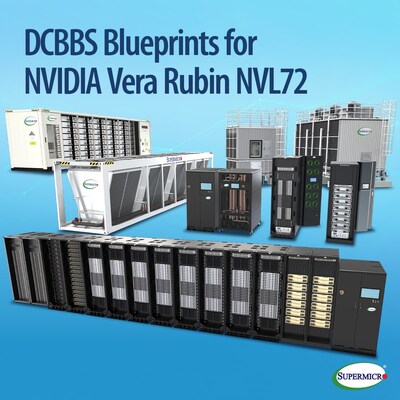
- Advanced Direct Liquid Cooling technology stack (DLC-2), including 5MW cooling towers, 4x in-row cooling distribution units (up to 1.8MW each), 16x vertically mounted cooling distribution manifolds, and 576 direct-to-chip copper cold plates (1 per every host processor module). Featuring Supermicro SMC PG25-A coolant engineered to deliver exceptional chemical and thermal stability. Liquid-to-air options will be available to support Vera Rubin NVL72 deployment in facilities without liquid cooling infrastructure, including a 200kW option supporting one rack and a 500kW option supporting two racks.
- Power Distribution Infrastructure from medium-voltage transformers through low-voltage distribution, rack-level power shelves, and battery backup units (BBUs). Each Vera Rubin NVL72 rack includes four 110 kW power shelves with redundant 18.3 kW power supply units. The DCBBS portfolio supports mission-critical data centers, with options including Supermicro's Battery Energy Storage System (BESS) providing instant-switching backup power.
- 48U and 52U rack enclosure options optimized for high-density direct liquid cooling.
- 16x compute racks optimized for the NVIDIA Vera Rubin NVL72 and NVIDIA HGX Rubin NVL8 platforms.
- 6x networking racks (4x compute, 2x converged) support NVIDIA Spectrum-X Ethernet or NVIDIA Quantum-X800 InfiniBand up to 1.6TB/s for the compute fabric. Options will be available for silicon photonics networking with co-packaged optics (CPO) for improved operational cost, power efficiency, and resiliency without pluggable transceivers.
- 4x high performance storage racks based on the Supermicro Petascale server platform for NVMe-tier application storage, model training checkpointing, and more.
2x context memory storage platform racks streamlined to handle the needs of long-context inference, agentic working memory, and retrieval workloads.
For more information visit https://www.supermicro.com/en/accelerators/nvidia/vera-rubin.
Supermicro's DCBBS Blueprint Ensures Single-Vendor Accountability
A typical AI infrastructure buildout involves more than a dozen distinct supplier relationships across compute, storage, networking, racks, cooling distribution, cooling towers, power infrastructure, battery backup, cabling, transceivers, and services. When these relationships are managed across multiple vendors, every vendor handoff introduces schedule risk and accountability gaps that slow deployments and complicate troubleshooting processes.
The DCBBS Blueprints for NVIDIA Vera Rubin NVL72 and NVIDIA HGX Rubin NVL8 are now available for customer engagements with deployments scheduled for the second half of 2026 aligned with NVIDIA Vera Rubin general availability. Supermicro will demonstrate the NVIDIA Vera Rubin NVL72 and NVIDIA HGX Rubin NVL8 platforms at Computex booth N0824, June 2-6, 2026, in
About Super Micro Computer, Inc.
Supermicro (NASDAQ: SMCI) is a global leader in Application-Optimized Total IT Solutions. Founded and operating in
 View original content to download multimedia:https://www.prnewswire.com/news-releases/supermicro-introduces-dcbbs-blueprints-for-nvidia-vera-rubin-nvl72-and-nvidia-hgx-rubin-nvl8-built-to-scale-from-5mw-to-1gw-as-an-end-to-end-total-solution-302786517.html
SOURCE Super Micro Computer, Inc.